
Notation · shorthand used below
Recall@kevidence coverage
Macro-averaged per-question gold-evidence-item coverage at depth k: the fraction of a question's distinct gold evidence items found in the top k, averaged over questions.
Hit@kany-evidence hit
Whether any gold evidence was retrieved in the top k, averaged over questions. Supplementary only.
MRRmean reciprocal rank
One over the rank of the first unit matching any gold evidence, averaged over questions; zero when nothing matches.
Available-PDF
The 135 questions whose source documents were ingested: the fair basis for comparing methods. The complete population keeps all 150.
CEcross-encoder
A reranker that scores the question and a candidate jointly. Here it reorders a first stage's top 50 and keeps 10.
Coverage
Correct answers over successful generations. Answered-conditional accuracy divides the same count by answered responses.
pppercentage points
The arithmetic gap between two rates. A move from 10% to 22% is 12 percentage points.
Holm p
A p-value adjusted with Holm's step-down method across the twelve saved paired tests.
95% CIconfidence interval
A paired percentile bootstrap over questions, 10,000 resamples. An interval touching zero is not distinguishable from no change.
Chapter 1
Introduction
Background and Motivation
Enterprise use of large language models (LLMs) is constrained by their reliance on parametric knowledge, which can become outdated and can produce unsupported content when a model is queried beyond what it reliably encodes (Lewis et al., 2020; Ji et al., 2023). In organisational knowledge work, where answers must be grounded in the organisation's own documents and errors carry financial, legal or reputational consequences, this is a material reliability problem.
Retrieval-Augmented Generation (RAG) mitigates this limitation by conditioning generation on retrieved evidence (Lewis et al., 2020). Its reliability therefore depends on what the retrieval stage places before the generator, since an answer cannot be grounded in evidence that was not retrieved. Retrieval failure is consequently a major source of downstream error in RAG systems (Ru et al., 2024).
Sparse and dense retrieval fail on different kinds of queries. Dense methods capture semantic similarity (Karpukhin et al., 2020), whereas lexical methods such as BM25 remain competitive where exact terms, identifiers or figures matter, particularly out of domain (Robertson & Zaragoza, 2009; Thakur et al., 2021). Neither is an obvious default here. Both also depend on the fidelity of the extracted text they index.
This dependence on extraction is especially important for visually structured enterprise documents such as financial filings, where tables, charts and complex layouts can be degraded by standard PDF text extraction. Visual-semantic approaches such as ColPali instead retrieve over rendered page images, preserving layout information that may be lost in text-only representations (Faysse et al., 2025).
1.1Financial Documents as an Enterprise Test Case
This dissertation adopts financial documents as its evaluation domain. Corporate filings are a demanding and representative form of enterprise documentation because they combine long narrative sections with dense numerical tables and complex layouts, while many questions require locating precise figures across lengthy reports. In the United States, Form 10-K is an annual regulatory filing that most public companies must submit to the Securities and Exchange Commission; it provides a comprehensive overview of a company's business and financial condition and includes audited financial statements and detailed disclosures (U.S. Securities and Exchange Commission, 2021). FinanceBench (Islam et al., 2023) provides realistic filings with expert-curated questions, gold answers and evidence passages indexed to source pages. This makes retrieval quality directly measurable against annotated evidence locations.
Problem Statement
Although a variety of retrieval strategies exist, there is limited systematic evidence about how these strategies compare on realistic enterprise document collections, and about how retrieval quality propagates to the faithfulness of generated answers. Practitioners building enterprise RAG systems therefore lack an empirical basis for selecting and configuring retrieval pipelines. Additionally, the evaluation of retrieval itself is non-trivial: benchmark evidence annotations must be reliably mapped onto the chunks produced by an ingestion pipeline, a step that is rarely reported in detail but which materially affects the validity of any reported metrics.
Aim and Objectives
The aim of this dissertation is to systematically evaluate retrieval and reranking strategies for enterprise Retrieval-Augmented Generation over complex financial documents, and to examine the relationship between retrieval quality and answer faithfulness. The project is designed as an evaluation-driven experimental study rather than a production system build.
This aim is pursued through the following objectives:
- To construct a reproducible evaluation pipeline over the FinanceBench dataset, including document ingestion, chunking, and a calibrated mapping between benchmark evidence annotations and extracted document content.
- To implement and evaluate sparse (BM25), dense (embedding-based), and hybrid (Reciprocal Rank Fusion) retrieval methods under a common experimental protocol, using established ranking metrics.
- To evaluate the effect of cross-encoder reranking applied to each first-stage retrieval method.
- To implement a grounded answer-generation stage with citation support, and to design an evaluation of answer faithfulness conditioned on retrieval quality.
- To assess the feasibility, practical requirements, and limitations of visual-semantic page retrieval (ColPali) for financial document question answering.
Research Questions
The study is structured around three research questions:
- RQ1. How do sparse, dense, and hybrid retrieval methods compare in retrieving supporting evidence from complex financial documents?
- RQ2. Does cross-encoder reranking improve retrieval quality over first-stage retrieval methods, and does improved retrieval support more faithful answer generation?
- RQ3 (Extension). What are the practical requirements and limitations of applying visual-semantic page retrieval, such as ColPali, to financial document question answering?
RQ1 establishes the empirical baseline and RQ2 builds on it; RQ3 is scoped as an extension study concerned with feasibility rather than definitive benchmarking, reflecting its computational requirements and its status as an emerging technique.
Scope and Dissertation Structure
The scope of this work is deliberately bounded. The system under study is an experimental evaluation pipeline, not a user-facing application: no claims are made about interface design, deployment, or operational concerns such as latency at scale. The evaluation is conducted on a single, publicly available benchmark; the findings are therefore most directly applicable to financial question answering, though the discussion considers their wider relevance to enterprise document retrieval. Visual-semantic retrieval is examined at the level of feasibility and practical requirements.
The dissertation reviews the literature and research gap, explains the methodology and implementation, presents and discusses the findings, and concludes with further work.
Chapter 2
Literature Review
This chapter reviews the literature that underpins the study. It moves from why retrieval-augmented generation suits enterprise knowledge access, through the characteristics of complex financial documents that make retrieval over them difficult, to the retrieval strategies themselves: sparse and dense first-stage methods, hybrid rank fusion and neural reranking, and visual-semantic retrieval over document images. It then examines how retrieval quality and answer faithfulness are evaluated, before Section 2.7 draws these strands together and states the research gap that motivates the dissertation.
2.1Retrieval-Augmented Generation and Enterprise Knowledge Access
The parametric knowledge encoded by large language models supports fluent generation, but it is not easily updated after training and does not straightforwardly provide provenance for generated claims (Lewis et al., 2020). When models generate beyond what they reliably encode, they may produce plausible but unsupported content. This failure mode, commonly termed hallucination, is a major obstacle to deploying language models where factual reliability matters (Ji et al., 2023). These limitations compound in enterprise settings, where organisational knowledge changes continuously and answers carry financial, legal or regulatory weight, so unattributable output is unusable even when it happens to be correct.
Retrieval augmentation responds by separating knowledge from the model, holding it in an external index over a document collection and conditioning generation on passages retrieved from it (Figure 2.1). Guu et al. (2020) demonstrated that a retriever could be learned jointly with a language model during pre-training, and Lewis et al. (2020) formalised the retrieval-augmented generation (RAG) architecture for knowledge-intensive tasks, showing improvements over purely parametric baselines on open-domain question answering. The value of this separation extends beyond benchmark gains: the corpus can be updated without retraining, answers can carry citations a reader can check (Gao et al., 2023), and the model can operate over private collections it never saw during training. These properties explain why RAG has become a widely used architectural pattern for organisational document collections.
The architecture changes where failures occur, but it does not remove them. If the passage containing the answer is retrieved, the generator can ground its response and cite its source. If the relevant passage is not retrieved, the generator may abstain or produce an unsupported answer; in several FinanceBench configurations, incorrect answers were considerably more frequent than refusals (Islam et al., 2023). Those authors identified correct retrieval of the relevant information as critical to model performance. Generation quality still matters, but it operates within a ceiling set by retrieval: an answer can be grounded only in the evidence that retrieval places before the generator. That stage is the focus of this dissertation.
A further complication is that most retrieval research has been conducted on corpora that differ from enterprise collections: the standard evaluation setting is open-domain question answering over short encyclopaedic passages, whereas organisational corpora are dominated by long, formatted documents containing domain terminology, identifiers, and numerical content, where answers must often be traceable to a specific page or clause for audit purposes. The mismatch has measurable consequences. Thakur et al. (2021) showed through the BEIR benchmark that retrieval models tuned on one distribution frequently degrade, sometimes below untrained lexical baselines, when evaluated zero-shot on other domains. Conclusions about which retrieval strategy suits enterprise material cannot simply be borrowed from open-domain results; they must be established on documents that exhibit enterprise characteristics. This consideration motivates the choice of financial filings as the evaluation domain of this study.
2.2Complex Financial Documents and Financial Question Answering
Corporate financial filings are a demanding and representative instance of enterprise documentation. The Form 10-K reports introduced in Section 1.1 combine narrative discussion with dense numerical tables, footnotes and multi-column layouts, and the evidence needed to answer a question is frequently a specific figure inside a table, identified by a fiscal year and a line-item label, rather than a sentence in running text. Locating precise numerical evidence within long, visually structured documents is a different task from matching a short query against short encyclopaedic passages.
These characteristics stress a retrieval pipeline at two distinct points. At ingestion time, PDF text extraction over complex layouts is fragile: tabular structure may be flattened, reading order scrambled, and chart content lost entirely, a weakness that motivates the visual retrieval methods reviewed in Section 2.5, which operate on page images instead (Faysse et al., 2025; Yu et al., 2025). Whatever extraction discards is unrecoverable downstream, since every text-based retrieval method operates on the extracted representation. At retrieval time, analyst queries mix exact lexical anchors, such as fiscal years and line-item names, with semantic paraphrase, so both lexical and semantic matching are exercised at once. Chunking adds a further tension. Segmenting long documents into retrievable units improves granularity, but it risks separating a table from the narrative that identifies what the table reports. Decisions made during ingestion determine what the retrieval stage can in principle recover, which is why this study treats ingestion and evidence alignment as first-class methodological concerns rather than incidental engineering details.
A line of financial question answering benchmarks documents how demanding this setting is, but most of it measures a different capability from the one at issue here. FinQA (Chen et al., 2021) and TAT-QA (Zhu et al., 2021) test multi-step numerical reasoning and joint table-text reasoning respectively, but both supply the relevant table or passage as input, so both measure reasoning over given evidence rather than the ability to find that evidence in a large document collection. FinTextQA is a closer precedent, benchmarking full RAG pipelines under noisy retrieval conditions (Chen et al., 2024), although its textbook and regulatory corpus and long-form answer format differ from the filing-level, page-indexed evaluation required here. FinanceBench addresses that requirement directly.
The FinanceBench benchmark was constructed to expose these difficulties at document scale (Islam et al., 2023). It pairs each question about a publicly traded company with a gold answer and a verbatim evidence string indexed to a page in the source filing, spanning information extraction, numerical reasoning and logical reasoning. Its scope should nonetheless be stated: the questions were deliberately written to be clear-cut, serving as a minimum performance standard rather than a test of advanced financial analysis, the documents are filings from publicly traded United States companies, and the published model evaluation covered 150 cases (Islam et al., 2023). Conclusions drawn on FinanceBench therefore describe one demanding but bounded setting rather than every form of financial analysis or enterprise documentation. Within that scope it suits this study well, because its page-indexed evidence annotations allow retrieval quality to be measured directly against annotated evidence locations instead of being inferred from downstream answer accuracy. Using them is not automatic, however, because benchmark page references must be reconciled with the pages and chunks produced by the ingestion pipeline. That calibration requirement is developed in Chapter 3, where Figure 3.2 shows a representative record with its annotated evidence, and the comparison demanded by RQ1 is conducted on this benchmark.
2.3Sparse and Dense Retrieval
The document characteristics established in Section 2.2 place competing demands on a retriever: exact matching of figures, fiscal years, line-item labels, and specialist financial terminology; recognition of semantic paraphrase in analyst queries; and resilience to text that extraction has flattened or fragmented. No single retrieval paradigm is designed to satisfy all of these demands at once, which is why their comparison is the subject of RQ1. Figure 2.2 summarises the retrieval approaches considered in this dissertation.
Sparse lexical retrieval represents queries and documents as weighted term vectors and scores them by term overlap. Its most established instantiation is BM25, a probabilistically motivated ranking function that combines term frequency saturation, inverse document frequency, and document length normalisation (Robertson & Zaragoza, 2009). The parameter values used in this study are reported in Chapter 3. BM25 requires no training data, is inexpensive at both indexing and query time, and produces scores that can be interpreted in terms of matched vocabulary. Its main strength is lexical precision: queries containing specific figures, entity names, fiscal years, or line-item labels match exactly against documents containing the same tokens, without any learned representation. This suits financial filings, where the discriminating signal often lies in company-specific language, financial identifiers, and uncommon numeric or textual expressions that appear verbatim in both query and document. Its main weakness is the vocabulary mismatch problem. Semantically equivalent formulations that share no surface terms, such as revenue against turnover, produce no lexical signal and are missed entirely.
Dense retrieval inverts this profile. Queries and passages are embedded into a shared continuous vector space by a learned encoder, and retrieval reduces to nearest-neighbour search over pre-computed passage vectors. Karpukhin et al. (2020) showed that a bi-encoder trained on question-passage pairs could substantially outperform BM25 on open-domain question answering, and Reimers & Gurevych (2019) adapted pre-trained transformers to produce sentence embeddings suitable for large-scale similarity search. Dense retrieval handles paraphrase and semantic relatedness well, exactly where BM25 fails, but it gives up some of what BM25 provides: fine-grained lexical distinctions, rare terms, and exact numerical or identifier matching are represented only approximately in a fixed-dimensional embedding, and effectiveness depends on how closely the deployment domain resembles the encoder's training distribution. The BEIR results make this dependence concrete: across heterogeneous zero-shot tasks, dense retrievers frequently underperformed the untrained BM25 baseline (Thakur et al., 2021). Neither paradigm dominates. Which one fails on a given query depends on whether the query's discriminating signal is lexical or semantic, which is the premise behind hybrid retrieval: lexical and semantic signals carry different information, and neither should be discarded.
2.4Hybrid Retrieval and Neural Reranking
The complementary error profiles described above supply the motivation for hybrid retrieval. A query that fails under one paradigm may succeed under the other, so a fused ranking can in principle outperform either component. How the fusion is performed matters. Score-based combination must contend with the incomparability of score distributions across systems, since BM25 scores and cosine similarities live on different scales and cannot be summed meaningfully without normalisation, which introduces tuning choices of its own. Rank-based fusion sidesteps the problem by discarding scores altogether. Reciprocal Rank Fusion (RRF), a widely used rank-based method, assigns each document a score proportional to the reciprocal of its rank in each result list, dampened by a constant, and merges lists by summed score (Cormack et al., 2009). Given a set of ranked result lists, the fused score of a document is
where is the position of in list and is a constant that dampens the influence of high ranks. For hybrid retrieval contains the BM25 and dense result lists, so their rank positions combine directly without normalisation. Cormack et al. (2009) showed that this nearly parameter-free scheme outperformed considerably more elaborate rank-learning methods, and its robustness to heterogeneous score scales has made it a common rank-fusion baseline.
Two caveats temper this appeal. First, RRF applies identical behaviour to every query, whether the query's discriminating signal is lexical or semantic, so it cannot exploit query-level knowledge about which component to trust. This limitation motivates the adaptive weighting direction identified as future work in this dissertation. Second, fusion is not guaranteed improvement. Where one component is systematically stronger on a collection, merging in a weaker ranking can push noise towards the top of the list. Recent analysis supports this caution: Bruch et al. (2024) examined fusion functions directly, found RRF sensitive to its rank-dampening parameter, and showed that a tuned convex combination of normalised scores outperformed RRF in both in-domain and out-of-domain settings. Rank-based fusion is best regarded as a strong and convenient baseline rather than a settled optimum. Whether hybrid fusion helps on a particular corpus is an empirical question, and it is this question that RQ1 poses for financial documents.
A second, largely orthogonal line of improvement restructures retrieval as a multi-stage pipeline. First-stage retrievers must scale to the full collection, so they rely on representations computed independently of the query, whereas rerankers operate only on a small candidate pool and can afford more expressive scoring. Cross-encoder rerankers concatenate the query and a candidate passage into a single transformer input, allowing full token-level interaction, and score each pair directly. Nogueira & Cho (2019) demonstrated large gains in ranking effectiveness from applying such a reranker to BM25 candidates, and sequence-to-sequence rerankers extended those gains across model families and scales (Nogueira et al., 2020). The trade-off shapes how such systems must be evaluated: joint encoding is far too expensive to apply to an entire collection, so the reranker sees only what the first stage surfaces. It can reorder the candidate pool but cannot recover evidence absent from it, which means its contribution is bounded by first-stage recall. Equally, strong first-stage recall can be wasted by poor ordering if no reranking is applied. First-stage recall and post-reranking order are distinct quantities that must be assessed separately, a point taken up in Section 2.6 and central to RQ2. Figure 2.3 illustrates how a reranker reorders a first-stage candidate list.
Each (query, candidate) pair is scored jointly; first-stage retrieval produced the candidates without that interaction.
First-stage ranking
- 1A
- 2B
- 3C
- 4D
- 5E
Reranked ranking
- 1C
- 2A
- 3D
- 4B
- 5E
2.5Visual-Semantic Retrieval for Complex Documents
Between the bi-encoder and cross-encoder extremes sits late interaction, introduced by ColBERT (Khattab & Zaharia, 2020). Queries and documents are encoded independently into per-token embedding sets, and relevance is computed by a MaxSim operator that matches each query token against its most similar document token. Writing for the query-token embeddings and for the document-token embeddings, the relevance score is
so each query token contributes its single strongest interaction with any document token, and these maxima are summed into the score (Khattab & Zaharia, 2020). This differs from a single-vector dense retriever, which compresses an entire passage into one embedding and compares it to one query embedding with a single dot product: late interaction instead preserves token-level detail and defers the query-document comparison to scoring time. It recovers much of the effectiveness of full token-level interaction while keeping document encoding offline, at the cost of storing many vectors per document instead of one, an overhead that later work reduced substantially through residual compression (Santhanam et al., 2022) and which is therefore an active engineering target rather than a fixed price. The design matters here mainly because it provides the architectural foundation for retrieval over document images.
Querying document images directly builds on visual document understanding research, which established that page appearance carries information text-only processing does not capture (Mathew et al., 2021). ColPali (Faysse et al., 2025) brings this perspective to retrieval, applying a vision-language model to page images to produce patch-level embeddings in the language model's embedding space and matching query token sets against page patches using the same MaxSim mechanism of Equation (2.2). The design removes the text-extraction stage entirely, so tables, charts, and layout that extraction pipelines degrade or discard are represented natively in the visual embedding. Figure 2.4 contrasts this process with a conventional text-extraction pipeline, and Figure 2.5 illustrates the token-to-patch matching schematically. The original evaluation reported substantial improvements over text-based pipelines on visually rich document retrieval benchmarks (Faysse et al., 2025), and the approach is a natural candidate for financial filings, where the evidence for many questions sits in tabular content that text extraction handles worst. Follow-on work extends the idea into generation: VisRAG retrieves page images and generates answers directly with a vision-language model, reporting end-to-end gains over text-based RAG pipelines on multimodal documents (Yu et al., 2025).
Conventional text retrieval
ColPali visual page retrieval
rendered page, cut into visual patches
| : FY2023 | |||||||
|---|---|---|---|---|---|---|---|
| : total | |||||||
| : revenue |
row maxima
These gains come with a cost profile that differs in kind from text-based retrieval. Producing page embeddings requires GPU inference through a multi-billion-parameter vision-language model at indexing time, and each page is represented by on the order of a thousand low-dimensional patch vectors instead of a single embedding (Faysse et al., 2025). The storage consequences are material: in the comparison reported by Yu et al. (2025), a ColPali-style multi-vector page representation required roughly fifty times the storage of a single-vector page embedding, and late interaction further requires purpose-built index structures and more expensive query scoring. Gains reported on curated visual-retrieval benchmarks also do not automatically transfer to a specific corpus and question distribution, for the same distribution-shift reasons that BEIR documented for dense text retrieval. Visual-semantic retrieval is best described as an emerging approach that is promising for visually rich documents, including financial filings, but not yet established as a practical or superior choice for the setting studied in this dissertation. Whether its benefits justify its infrastructure demands on a given collection is an open empirical and practical question. Reflecting this cost profile and the recency of the technique, the present study treats it as a feasibility investigation, examining practical requirements and limitations rather than claiming a definitive benchmark comparison, as set out in RQ3.
2.6Evaluation of Retrieval Quality and Answer Faithfulness
Failures in retrieval-augmented systems originate at different stages: evidence may never survive ingestion, may not be retrieved, may be retrieved but ranked too low to reach the generator, or may reach the generator and still not be used faithfully. End-to-end answer accuracy collapses these distinct failures into a single number and cannot attribute error to its source. A system may answer correctly from parametric knowledge despite retrieval having failed, in which case the answer is unattributable and the apparent success is misleading. A wrong answer may equally reflect a generation failure over perfectly retrieved evidence. For a study whose research questions concern retrieval strategies, evaluation must separate retrieval quality from answer quality, measuring the former directly against ground-truth evidence and the latter conditioned on what was retrieved. The separation also makes multi-stage architectures interpretable, since a reranker cannot recover what first-stage retrieval missed (Section 2.4).
Retrieval quality is conventionally measured with rank-based metrics over a labelled set of relevant items. Recall@ measures how much of the relevant evidence for a question appears in the top results. Where a question is supported by several annotated evidence items these are distinct quantities: the fraction of those items recovered is not the same measure as a binary indicator of whether any relevant evidence was retrieved, and this study reports the former as its primary measure and the latter separately, both defined operationally in Chapter 3. Because the generator is conditioned only on the retrieved context, evidence outside the top cannot be used at all, so Recall@ bounds the annotated evidence made available to downstream generation rather than the faithfulness of the response produced from it. Ranking quality near the top of the list is characterised separately by Mean Reciprocal Rank (MRR), which averages the reciprocal rank of the first relevant result; it originates in question-answering evaluation where a single correct item is sought (Voorhees, 1999) and is informative when questions are supported by one primary evidence location. No single metric suffices. Recall@ ignores ordering within the top , while MRR can look healthy even when total coverage is poor. Reporting them together is what allows first-stage coverage and ranking quality to be distinguished, and this distinction is what RQ1 and the first half of RQ2 rest on.
Applying these metrics presupposes ground truth about which retrieved units are relevant, and here the design of FinanceBench matters. Because each question is paired with a verbatim evidence string and a source page reference (Islam et al., 2023), relevance can be established at the level of evidence locations rather than inferred from final answer correctness. This enables the direct measurement of retrieval quality argued for above, but it requires care. The units a pipeline retrieves are chunks of extracted text, whereas the annotations refer to strings and pages in the original PDF. Extraction alters whitespace, hyphenation, and table structure, so exact string matching against extracted chunks is brittle, and the page numbering used by a benchmark need not coincide with the page indexing produced by an extraction tool. Evidence-level evaluation consequently requires an explicit, audited alignment between benchmark annotations and the pipeline's chunk and page representations. This calibration step is not consistently reported in sufficient detail in published evaluations, yet the validity of every retrieval metric depends on it. The procedure adopted in this study is developed in Chapter 3.
Retrieval metrics say nothing about what the generator does with the evidence, and correctness alone is insufficient in both directions. An answer may be correct yet unsupported by the retrieved context, produced instead from parametric knowledge, which defeats the attributability that justifies RAG in the first place; and a fluent, confident answer may be wrong in ways a reader cannot detect without checking sources, which is the failure mode that makes hallucination dangerous. A fuller assessment therefore separates faithfulness, whether the claims in the answer are entailed by the retrieved evidence, from evidence support and citation accuracy, whether the passages the answer cites actually contain the supporting material, and from numerical correctness, since financial answers turn on exact figures, units and fiscal periods where approximate agreement is failure. Completeness is a further dimension, since an answer may be accurate and well supported in what it states yet omit part of what the question requires. Abstention needs particular care: a system that answers everything fabricates when retrieval fails, while one that abstains too readily is useless, so false answers and unnecessary refusals must be measured jointly rather than collapsed into a single accuracy figure. Benchmarks now target several of these dimensions directly, ALCE by formalising citation precision and recall and finding that even strong models frequently produce citations that do not support the associated claims (Gao et al., 2023), and RAGTruth by supplying word-level human annotations of unsupported content against which hallucination can be measured (Niu et al., 2024). The FinanceBench results discussed in Section 2.1 show how much this joint view reveals compared with accuracy alone (Islam et al., 2023).
The cost of multi-dimensional assessment has motivated automated evaluation frameworks, which make large-scale assessment tractable by having language models judge the outputs. RAGAS scores faithfulness, answer relevance and context relevance without hand-annotated ground truth (Es et al., 2024); ARES calibrates lightweight judge models against a small human-annotated sample (Saad-Falcon et al., 2024); and RAGChecker decomposes responses into individual claims to yield separate diagnostic metrics for the retriever and the generator (Ru et al., 2024), corroborating the argument of this section that errors must be attributed to the stage that caused them. Their taxonomies support the separation argued for here, but their limitations in this setting should be stated plainly. Judgements produced by language models inherit the variance and biases of the judge, which limits exact reproducibility; the frameworks are generic by design, with no native notion of page-level evidence references, exact numerical agreement or benchmark-calibrated abstention; and reference-free scores are difficult to audit in a domain where auditability is the point. Where gold evidence strings, page references and exact answers already exist, as they do in FinanceBench, evaluation can instead be anchored to that ground truth through deterministic checks, with judge-based metrics as complements rather than substitutes. This reasoning informs the evaluation design of Chapter 3, and it gives the second half of RQ2, whether improved retrieval supports more faithful generation, an operational meaning.
2.7Synthesis and Research Gap
The literature reviewed in this chapter provides strong foundations, but its findings pull in different directions rather than settling into consensus. Dense retrieval outperformed BM25 convincingly on open-domain question answering (Karpukhin et al., 2020), yet under domain shift dense models frequently fell below the untrained lexical baseline (Thakur et al., 2021), and financial questions exercise precisely the mixture of exact lexical and numerical anchors and semantic paraphrase on which the two paradigms fail differently. Fusion promises a reconciliation, but its evidence is unsettled: Cormack et al. (2009) found nearly parameter-free rank fusion difficult to beat, while Bruch et al. (2024) showed it to be parameter-sensitive and beatable by tuned score combination. Cross-encoder reranking delivers consistent ordering gains (Nogueira & Cho, 2019; Nogueira et al., 2020), yet those gains remain bounded by whatever the first stage surfaces. Visual-semantic retrieval reports substantial improvements on visually rich benchmarks (Faysse et al., 2025; Yu et al., 2025) while carrying storage and inference costs that differ in kind from text retrieval, and although finance-specific multimodal retrieval benchmarks have since appeared (Zhao et al., 2025), its performance alongside the text-based baselines under the controlled FinanceBench protocol adopted here remains untested. Evaluation practice shows a parallel tension between generic model-judged frameworks that make assessment tractable (Es et al., 2024; Saad-Falcon et al., 2024) and the transparent, evidence-grounded measurement that auditable financial question answering requires. These tensions cannot be settled for the present setting from the published evidence alone, because the studies reviewed do not evaluate these retrieval families together under a single protocol on page-indexed financial evidence.
Recent work has begun to address financial retrieval directly. HiREC evaluates hierarchical retrieval with evidence curation over a large corpus of SEC filings (Choe et al., 2025); FinCARDS treats evidence selection over long corporate filings as a structured reranking problem (Zhou et al., 2026); and FinRAGBench-V introduces a multimodal retrieval benchmark with visual citation for the financial domain (Zhao et al., 2025). A recent preprint also compares dense, hybrid, and reranked FinanceBench pipelines (Dadopoulos et al., 2025), and a concurrent preprint decomposes retrieval failure by document, page, and chunk granularity over the same open-source FinanceBench subset, comparing sparse, dense, hybrid, and hierarchical retrieval with reranking and query reformulation (Kobeissi & Langlais, 2026). What remains scarce is evidence comparing sparse BM25, dense, hybrid RRF, and their cross-encoder-reranked counterparts under one controlled FinanceBench protocol, with relevance established against page-indexed gold evidence through an audited alignment procedure and with the propagation from retrieval quality to grounded answer generation examined in the same setting. Neither of those preprints reports an audited page-to-chunk alignment between benchmark annotations and the retrieved units, and neither compares the six retrieval configurations examined here, comprising three first-stage methods and their cross-encoder-reranked counterparts, under a single protocol, or separates results for the complete and available-PDF populations. The first relates retrieval to generation through a model-judged evaluation framework rather than through deterministic evidence-location matching with separate measurement of abstention and citation provenance, and the second evaluates generation against reference answers rather than by attributing outcomes to the retrieval stage in that way. Neither examines visual-semantic page-image retrieval alongside the text-based baselines. Individual components have been validated largely in isolation, and predominantly on open-domain corpora whose transfer to enterprise material is unreliable, as the BEIR results demonstrate. Evidence alignment between benchmark annotations and pipeline representations, on which the validity of any such comparison rests, is likewise not consistently reported in sufficient detail. This is the narrower evaluation and reproducibility gap that the present dissertation addresses. RQ1 follows from the sparse, dense, and hybrid retrieval literature and asks how these methods compare on FinanceBench under one protocol. RQ2 follows from the reranking and faithfulness literature and asks whether cross-encoder reranking improves retrieval quality and whether better retrieval supports more faithful answers. RQ3 follows from the visual-semantic retrieval literature and asks what applying a ColPali-style approach to financial document question answering would practically require.
Chapter 3
Methodology
This chapter sets out the research design and experimental procedures of the study. The emphasis throughout is on what was done, why it was done, and how the validity of the comparisons required by the research questions was protected.
3.1Research Design
The study is designed as a controlled, evaluation-driven comparison. The object of investigation is an experimental evaluation pipeline in which alternative retrieval strategies are measured under identical conditions; it is not a production application or user-facing assistant, and no claims are made about interface or deployment concerns. RQ1 is addressed by comparing BM25, dense retrieval and hybrid Reciprocal Rank Fusion (RRF) under one shared protocol. RQ2 is addressed in two parts: cross-encoder reranking is applied to the candidate pools of each first-stage method and assessed under the same protocol, and a grounded answer-generation stage is then examined so that retrieval quality can be related to answer faithfulness. RQ3 was initially scoped as a feasibility assessment, reflecting the cost profile and recency of the technique, and following successful CUDA validation was extended to a separate page-level retrieval comparison over the complete available-PDF population.
The pipeline is organised into seven numbered stages, from dataset acquisition and corpus construction through to grounded answer generation and evaluation (Figure 3.1). Stage 6 operates on rendered page images and is evaluated separately from the chunk-level configurations compared under RQ1 and RQ2, because it retrieves a different unit. The stages are evaluated separately because their failures have different causes: a question may fail because its source document never entered the corpus, because retrieval did not surface the annotated evidence, because ranking placed that evidence below the retrieval depth, or because generation did not use retrieved evidence faithfully. Collapsing these failure modes into a single end-to-end figure would make the comparisons required by RQ1 and RQ2 uninterpretable.
branches from stage 1
Several controls support a fair comparison. Within the chunk-level RQ1 and RQ2 comparison, every method was evaluated on the same FinanceBench questions over the same ingested chunk corpus; relevance was decided by the same evidence-matching procedure; retrieval-depth conventions and evaluation metrics were held constant across methods; and results were reported separately for the complete benchmark and for the available-PDF population defined in Section 3.3, so that corpus availability could not be mistaken for retrieval behaviour.
3.2Dataset and Document Corpus
The evaluation dataset is FinanceBench, a benchmark of questions over public corporate financial filings in which each question carries a gold answer and verbatim evidence indexed to a source page (Islam et al., 2023). The dataset was obtained from the publicly released PatronusAI/financebench distribution, whose open-source subset contains 150 annotated examples (Patronus AI, n.d.), and was cached locally once before any experiment was run, so that working from a fixed file rather than re-downloading the distribution keeps the question set identical across runs. The pipeline loads all 150 questions by default; these carry 189 gold evidence items and reference 84 financial-report documents. Multiple evidence records attached to a single question were preserved, so a question may have more than one gold evidence item and more than one relevant page.
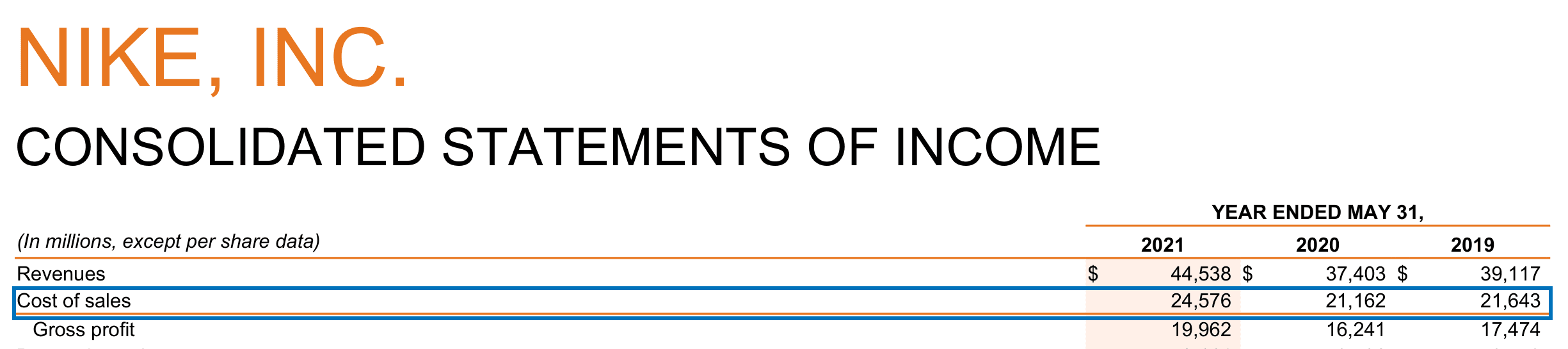
For each question the pipeline used the question identifier, question text, gold answer and document name, together with each nested evidence object's text, full-page text, page number and recorded document name (Patronus AI, n.d.). Attributes such as company, sector, document type and question type were retained as metadata but did not alter retrieval behaviour. No filtering by question type was performed, and the default retrieval and reranking experiments used every question rather than a sampled subset. Figure 3.2 shows one record alongside a source page carrying its annotated evidence.
(a) Selected fields of the FinanceBench record
| Identifier | financebench_id_04080 |
|---|---|
| Document | NIKE_2021_10K (Form 10-K, FY2021, 109 pages) |
| Question | When primarily referencing the income statement and the statement of financial position, what is the FY2021 inventory turnover ratio for Nike? Inventory turnover ratio is defined as: (FY2021 COGS) / (average inventory between FY2020 and FY2021). Round your answer to two decimal places. |
| Gold answer | 3.46 |
| Annotated evidence | Page 58, extracted page 59 (income statement); page 60, extracted page 61 (balance sheet) |
| Values carried by that evidence | Cost of sales 24,576; Inventories 6,854 (FY2021) and 7,367 (FY2020) |
| Gold answer obtained as |
(b) First annotated evidence page, extracted page 59
(c) Second annotated evidence page, extracted page 61
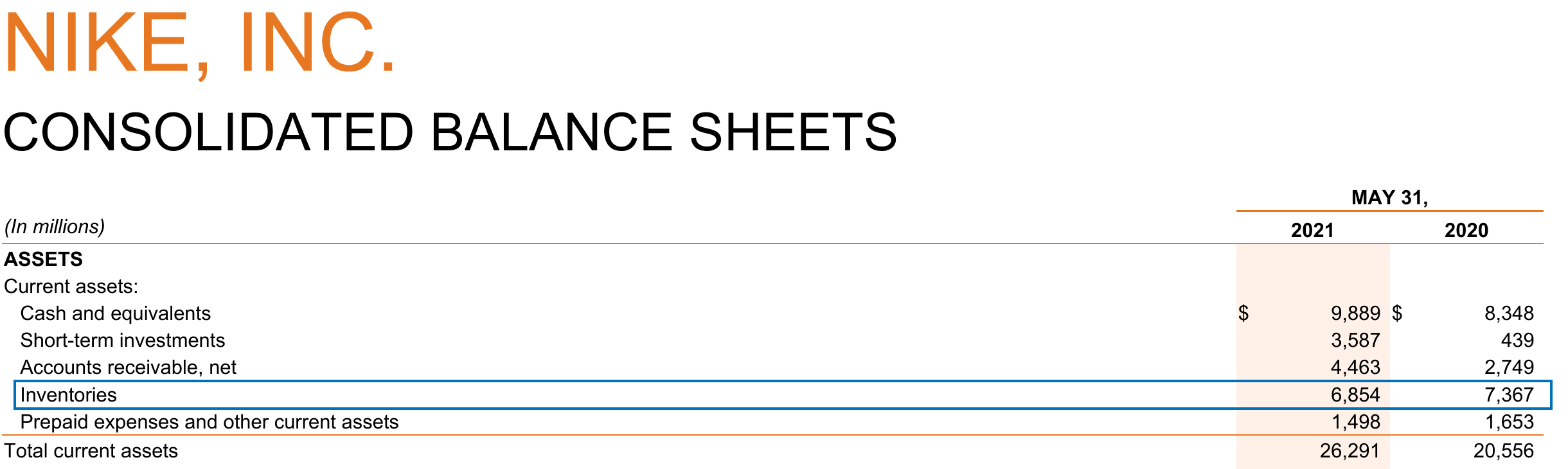
Each question carrying a gold answer, a verbatim evidence string and a source-page reference is what permits retrieval quality to be evaluated directly against annotated evidence locations rather than inferred from final answer accuracy alone, and it is that property the design depends on. The scope of the benchmark bounds the scope of the conclusions: it is a single financial benchmark built from filings of publicly traded United States companies, and findings on it should not be generalised automatically to every form of enterprise documentation.
3.3Document Acquisition and Dataset Coverage
The documents required by the benchmark were identified from the FinanceBench document names and the evidence metadata, and were expected as local PDF files under a normalised document-name convention. Where a document was not already available locally, the acquisition utility retrieved it using the doc_link URL supplied with the FinanceBench document metadata (Patronus AI, n.d.). These links resolve to company investor-relations sites and filing content-delivery endpoints rather than to a regulatory filing archive. Downloads were retained only after a successful response and a PDF file-signature check, and reported MIME types and file sizes were not used as acceptance criteria (Figure 3.3; Appendix C.2).
doc_linkPresence alone did not make a document usable. A PDF entered the corpus only if page-wise text extraction produced retrievable content; a document that was present but yielded no chunks was classified as unusable, a category that captures scanned or otherwise non-extractable files. Optical character recognition was not applied, so image-only documents remained outside the corpus. Missing and unusable documents were recorded and reported separately from retrieval failures, and the questions and evidence items affected by unavailable documents were identified automatically rather than by manual inspection.
The resulting corpus status defines the experimental populations. Of the 84 referenced documents, 75 were successfully ingested and 9 were unavailable, through two distinct mechanisms: documents that could not be retrieved from their published sources, and one, KRAFTHEINZ_2019_10K, that was downloaded but produced no extractable chunks. The complete population therefore contained all 150 questions, while the available-PDF population contained the 135 questions whose source documents were ingested.
Both populations were retained deliberately, and both were produced automatically under the same evaluation procedure. The all-question population preserves visibility of corpus-availability failures, which are genuine failures of a document-grounded system even though no retrieval method can be blamed for them. The available-PDF population provides the fair primary basis for comparing retrieval methods, because every included question has an ingested source document and differences in measured quality can be attributed to the methods themselves.
3.4PDF Ingestion and Chunking
Text was extracted from each ingested PDF using PyMuPDF 1.27.2.3 (Artifex Software, Inc., 2026) in its plain page-level text mode with no layout, clipping or sorting options, with every page processed independently. PyMuPDF iterates pages from zero, and the pipeline stores each extracted page as that zero-based index plus one; extracted page numbers are therefore one-based, a convention that becomes important when they are compared with the benchmark evidence page references in Section 3.5. Page boundaries were preserved throughout: chunks never crossed PDF pages, and blank pages produced no chunks. No optical character recognition, structural table reconstruction, header or footer removal, de-hyphenation or Unicode normalisation was applied, so complex tables and layouts are represented only through the linearised extractor text. Files that failed extraction were logged and skipped without terminating the ingestion run.
Extracted page text was segmented into fixed-size overlapping character windows under the parameters of Table 3.1; a short first chunk on a page could still be retained below the minimum length. Chunk identifiers were deterministic, and each chunk preserved the provenance fields listed in the table. A single shared corpus built under these settings was used by BM25, dense retrieval, hybrid retrieval, and cross-encoder reranking alike; the completed corpus contained 48,957 chunks drawn from the 75 ingested documents, a count recorded with the reported results in the run configuration snapshot.
p::c0 [0, 1000)p::c1 [800, 1800)p::c2 [1600, 2600)p::c3 [2400, 3100)Stored with every chunk
chunk_id DOCUMENT::p<page>::c<i> · document_id · source_filename · page_number · char_start · char_end · text
No OCR, no table reconstruction, no header or footer removal, no Unicode normalisation.
| Parameter | Active value |
|---|---|
| Extraction library | PyMuPDF 1.27.2.3, page-level plain-text mode |
| Page numbering | One-based extracted page numbers |
| Chunk unit | Fixed-size character window |
| Chunk size | 1,000 characters |
| Chunk overlap | 200 characters (effective step 800) |
| Minimum chunk length | 50 characters |
| Cross-page chunks | Not permitted; page boundaries preserved |
| OCR | Not used |
| Table extraction | None; linearised extractor text only |
| Stored provenance | Document identifier, filename, page, offsets, text |
These choices reflect the evaluation design rather than a claim about optimal ingestion. Preserving page boundaries makes evidence-page evaluation possible, since every chunk maps unambiguously to one extracted page, and the provenance each chunk carries supports citation and page-level evaluation later in the pipeline. Using one shared corpus prevents differences in chunking from confounding the comparison of retrieval methods, which is central to RQ1. The scheme is deliberately simple: it is not sentence-aware, token-aware, or table-aware, and the consequences of that simplicity for tabular evidence are considered with the results.
3.5Evidence Calibration
Evaluating retrieval directly against annotated evidence requires a trustworthy mapping between the benchmark's annotations and the corpus that the pipeline actually searches, and this mapping cannot be assumed. Two obstacles arise. First, FinanceBench records evidence_page_num under a zero-based convention (Patronus AI, n.d.), whereas the ingestion pipeline stores extracted pages under the one-based convention described in Section 3.4; comparing the raw numbers directly would label correctly retrieved evidence as non-relevant. Second, text extraction changes whitespace, line breaks, hyphenation, and table layout, so an annotated evidence string need not appear verbatim in any extracted chunk, which makes exact string matching alone unreliable. Evidence calibration addresses both obstacles before any retrieval method is evaluated.
Calibration was established through an audit applied across all available evidence records rather than a manually selected subset. For each evidence item, the chunks belonging to the gold document were identified and exact normalised substring matching was attempted. A best fuzzy match within the gold document was then used to infer the most likely extracted page for the evidence, and the difference between the annotated page and the inferred page was calculated. Candidate relationships corresponding to offsets of , , , and were inspected, and the modal detected offset was selected. Page tolerance was set to zero where the modal offset accounted for at least 80 per cent of detected cases. The audit selected a page offset of with a page tolerance of , consistent with the difference between the two page conventions described above. That offset was dominant rather than universal: a small number of evidence items were located at other offsets, which is one reason the text signal is retained alongside page matching rather than relying on page arithmetic alone. The fuzzy threshold was 85 on the 0 to 100 scale of the RapidFuzz partial-ratio scorer described later in this section; this threshold was a fixed operating value and was not selected through a threshold sweep.
The calibrated relevance decision is as follows. A retrieved chunk was considered relevant to a gold evidence item only when the normalised document identifiers agreed and either a text match or a calibrated page match succeeded; concisely, same document AND (text match OR page match). Document agreement is a strict precondition, so text resembling the evidence but originating in a different filing could never be counted. Figure 3.5 summarises the decision.
Text matching operated on normalised strings: evidence and chunk text were lowercased and whitespace was collapsed. The annotated evidence string was attempted first, with the full-page evidence text available as a fallback. When the normalised evidence contained at least 40 characters, exact substring matching was attempted. Approximate matching used RapidFuzz 3.14.1, a fuzzy string-matching library (Bachmann, 2025), whose partial_ratio scorer returns a similarity score on a 0 to 100 scale. Evidence was accepted as a fuzzy text match when partial_ratio reached at least 85, a threshold chosen for this study rather than a property of the library. Page matching compared the extracted page number plus the calibrated offset with the annotated gold page. Under the active values an extracted page matched FinanceBench page , and because the tolerance was zero, neighbouring pages were not accepted through page matching alone.
The audit record, covering all 189 evidence items, makes the behaviour of these criteria concrete, and Table 3.2 presents five recorded cases spanning the outcomes the procedure produces. They show why page arithmetic alone is insufficient and why the calibrated matcher is conservative rather than permissive; the cases are discussed individually in Appendix C.1.
data/outputs/evidence_mapping_audit.csv, 189 rows). The gold page is the annotated benchmark evidence page and the best page is the extracted page of the strongest recorded match. The outcome column is an analytical classification derived from the recorded score and offset fields rather than a single stored label.| Case | Document | Gold page | Best page | Recorded outcome |
|---|---|---|---|---|
| CVS Health | CVSHEALTH_2022_10K | 67 | 68 | Exact substring, score 100.0, offset |
| PepsiCo | PEPSICO_2022_10K | 25 | 26 | Approximate match, score 89.37, offset |
| Best Buy | BESTBUY_2017_10K | 55 | 20 | Text located, score 100.0, offset |
| AMD | AMD_2015_10K | 55 | 5 | No text match; acquired file is a five-page investor-relations web capture, not the intended filing |
| American Express | AMERICANEXPRESS_2022_10K | 154 | 155 | No text match, best score 81.32, below the threshold of 85 |
Questions with several gold evidence items retained all of them. A single retrieved chunk could match one or more evidence items, and top- evidence coverage was calculated from the distinct evidence items recovered within the retrieval depth. In the implemented evaluation, Recall@ denotes macro-averaged per-question gold-evidence-item coverage, while the supplementary any-evidence-hit rate represents the binary query-level formulation discussed in Section 2.6. Evidence items that could not be mapped to the corpus were not silently treated as retrieval failures: a question with no mappable evidence would be excluded and reported, although the completed dataset provided usable evidence for every loaded question.
The reported measures are defined as follows. Let be the evaluation population, the set of distinct gold evidence items for question , the top- retrieved units, and when retrieved unit is judged relevant to evidence item by the calibrated matcher defined above. Recall@ is then
so each question contributes the fraction of its own distinct gold evidence items recovered within the retrieval depth: a question with three evidence items of which one is recovered contributes . The supplementary any-evidence-hit rate is the binary question-level alternative,
which records only whether any gold evidence was retrieved and is not the primary measure. Writing for the rank of the first retrieved unit matching any gold evidence item, and taking the reciprocal rank to be zero when no such unit is retrieved, mean reciprocal rank (Voorhees, 1999) is
A normalised discounted cumulative gain is not reported, because relevance here is a binary judgement about evidence locations and several overlapping retrieved units may correspond to the same annotated evidence item: treating each matching unit as an independent relevant item would reward redundant retrieval, while crediting only the first would measure coverage diversity rather than graded relevance.
Calibration protects the validity of every comparison that follows (Appendix C.1). Most importantly, the same calibrated matcher was applied to every retrieval and reranking method, so measured differences between methods reflect the methods themselves rather than differences in the definition of relevance. The quantitative findings of the calibration audit are reported with the results.
3.6First-Stage Retrieval Methods
Three first-stage retrieval methods were evaluated over the shared chunk corpus of Section 3.4. Sparse lexical retrieval used the Okapi BM25 ranking function (Robertson & Zaragoza, 2009) as implemented by the rank-bm25 library. Queries and chunk text were tokenised identically, and no stop-word removal, stemming, or lemmatisation was applied, so matching operated directly on surface tokens. The index covered the complete corpus of 48,957 chunks.
Dense retrieval used the sentence-transformers/all-MiniLM-L6-v2 bi-encoder (Reimers & Gurevych, 2019). Chunk and query embeddings were computed by the same encoder and L2-normalised, and similarity search used an exact inner-product FAISS index (Johnson et al., 2021), under which inner product is equivalent to cosine similarity for normalised vectors. The full corpus was embedded once and the resulting index reused across experiments. All completed RQ1 and RQ2 chunk-level retrieval and reranking experiments executed on CPU.
Hybrid retrieval fused the BM25 and dense rankings with Reciprocal Rank Fusion (Cormack et al., 2009): for each query the top 50 candidates were taken from each component retriever and Equation (2.1) applied to one-based component ranks with rank constant 60, without component weighting. Appearances of the same chunk in both lists accumulated onto a single entry keyed by the chunk identifier, and the fused list was ordered by descending score and truncated to the evaluation depth.
BM25 top 5
- 1A
- 2B
- 3C
- 4D
- 5E
Dense top 5
- 1C
- 2A
- 3F
- 4G
- 5B
Fused by RRF, k = 60
- 1A1/61 + 1/620.03252
- 2C1/63 + 1/610.03227
- 3B1/62 + 1/650.03151
- 4F1/630.01587
- 5D1/640.01563
- 6G1/640.01563
- 7E1/650.01538
The comparative protocol held everything except the retrieval method constant. Every method answered the same FinanceBench questions, searched the same 48,957-chunk corpus produced by a single ingestion and chunking run, and was scored by the same calibrated relevance matcher of Section 3.5. Retrieval used a common depth of ten results per query, metrics were computed at , and results were reported for both the complete and available-PDF populations of Section 3.3. Table 3.3 summarises the active parameters.
| Parameter | Active value |
|---|---|
| BM25 | |
| Implementation | rank-bm25 0.2.2 (Okapi BM25) |
| , , | 1.5, 0.75, 0.25 (library default ) |
| Tokenisation | Lowercased [a-z0-9]+ matches |
| Term processing | No stop-word removal, stemming, or lemmatisation |
| Dense | |
| Encoder | sentence-transformers/all-MiniLM-L6-v2 |
| Encoder revision | 1110a243fdf4706b3f48f1d95db1a4f5529b4d41 |
| Encoder library | sentence-transformers 3.0.1 |
| Dimensionality | 384 |
| Normalisation | L2, queries and chunks |
| Index | faiss-cpu 1.14.3, exact inner product |
| Encoding batch size | 32 |
| Hybrid | |
| Components | BM25 and dense |
| Candidate depth | Top 50 per component |
| Fusion | RRF, constant 60, unweighted |
| Deduplication | By chunk identifier |
3.7Cross-Encoder Reranking
Cross-encoder reranking was applied as a second stage over each first-stage method, following the multi-stage design reviewed in Section 2.4 (Nogueira & Cho, 2019). The reranker was the cross-encoder/ms-marco-MiniLM-L-6-v2 model, at revision c5ee24cb16019beea0893ab7796b1df96625c6b8. For each question, a candidate pool of 50 results was drawn from each first-stage method: the top 50 BM25 candidates, the top 50 dense candidates, and a hybrid pool of 50 produced by fusing the two component lists under the same RRF configuration as Section 3.6. The three pools were reranked independently, so each first-stage method has a directly comparable reranked counterpart. The cross-encoder scored each question and candidate jointly in batches of 32, candidates were reordered by descending score, and the top 10 reranked results were retained. The first-stage top 10 and the reranked top 10 were evaluated with the identical calibrated matcher at , which isolates the effect of reranking from every other pipeline factor.
This design makes the candidate-pool ceiling explicit: evidence absent from the 50-candidate pool cannot be recovered by reranking, however accurately the pool is reordered, so differences between reranked methods reflect both the quality of the reordering and the composition of the pools they inherit. First-stage and reranked retrieval quality are therefore reported as separate quantities.
3.8Visual-Semantic Page Retrieval
The RQ3 assessment applied ColPali-style visual page retrieval (Faysse et al., 2025) to this corpus and measured it against a page-level text control under the same calibrated matcher. The unit of retrieval in this setting is the rendered page. Pages were rendered with PyMuPDF to PNG images at 120 dots per inch, with page numbering following the same one-based convention as the text pipeline. Page-level retrieval units were then assembled that carry both the rendered image and the page text reconstructed from the existing chunks, so the calibrated matcher of Section 3.5 applies unchanged at page level.
A retrieval adapter for the vidore/colpali-v1.2 model was implemented against the same retriever interface as the text methods and validated in a separate isolated CUDA environment over a 15-question pilot (Appendix C.3). The complete evaluation then covered the complete available-PDF population of 135 questions and all 75 ingested documents, rendered all 10,985 pages without a cap and retrieved at depth ten.
Macro-averaged evidence recall can be reported for both retrieval families under the same calibrated matcher, but same-depth results are not strictly like-for-like because a rank position denotes a whole page for ColPali and the page-text control, and a chunk for the RQ1 and RQ2 methods. The page-text backend therefore provides the primary controlled comparison for ColPali, while the chunk-level results provide wider pipeline context. Rank-sensitive measures such as MRR require the same caution. The measured results are reported in Chapter 5.
Chapter 4
Implementation
This chapter describes how the research design of Chapter 3 was realised in software. The rationale for the methods and the parameter values they ran under belong to that chapter and are cross-referenced rather than repeated here.
4.1Implementation Overview
The pipeline is a modular Python package whose modules correspond to the stages of Section 3.1.
Two abstractions carry most of the architectural weight. Every retrieval method implements a common interface, so the sparse, dense and hybrid methods can be selected by name and driven by one experiment loop, and reranking implements a parallel interface that accepts a candidate list and returns a reordered one. Because the methods are interchangeable behind them, the comparative controls of Chapter 3 are enforced by construction rather than by convention: no method-specific component can alter the corpus, the question set or the relevance matcher its rivals were judged against.
Retrieval and reranking were run to completion first and their ranked candidate lists written to disk; the answer-generation experiment then read those saved candidates back rather than recomputing them (Figure 4.1).
The two phases differ in scope. Retrieval evaluation covered all six configurations, whereas grounded generation used only four of them, so no claim about generated answers is made for the sparse configurations.
4.2Execution Environment
The pipeline ran locally on a CUDA-capable Windows workstation under Python 3.12. Text retrieval, reranking and deterministic evaluation ran on CPU, while language-model inference was served locally through LM Studio using its OpenAI-compatible API and the google/gemma-4-12b-qat model.
The ColPali path ran in a separate isolated CUDA environment (Appendix C.3).
4.3Data Pipeline and Corpus Representation
The pipeline does not operate on FinanceBench records directly. Each is normalised into an internal question record holding its gold evidence items (Appendix A.1). The original record is retained alongside the mapped fields, so nothing is discarded.
Extracted pages enter the shared page and chunk representation of Section 3.4 (Artifex Software, Inc., 2026), implemented as the Chunk class. Its identifiers are deterministic, so the same corpus build always produces the same identifiers and an identifier can be read as a location. Figure 4.2 shows where the two record shapes meet, and the supporting implementation detail appears in Appendix A.2.
QuestionExample
- id
- question
- answer (gold)
- doc_name
- evidence[]
- text, doc_name,
- page_num, full_page_text
Chunk
- chunk_id
- document_id
- page_number
- text
- char_start
- char_end
Indigo: the document name and page number both records carry, which is what lets an annotation be matched against a chunk.
Chunks are persisted once, and that single file is the corpus for every retrieval method.
These identifiers carry provenance through the whole pipeline. A retrieved result, a saved candidate record and a citation label in a generated answer all name the same chunk, so a cited claim resolves to a specific window in a specific filing rather than to a document in general, and the answer evaluator can compare cited material against the calibrated evidence annotations using the same matcher that decides retrieval relevance (Section 3.5).
4.4Retrieval, Indexing and Reranking Implementation
The components were configured under the parameters of Table 3.3. Sparse retrieval applies the shared tokeniser identically to chunks and queries, so document and query processing cannot diverge (Robertson & Zaragoza, 2009). Dense retrieval encodes the corpus with the Sentence-BERT bi-encoder (Reimers & Gurevych, 2019) and searches it through an exact inner-product FAISS index, IndexFlatIP (Johnson et al., 2021); because that search is exhaustive rather than approximate, no ranking difference is attributable to index approximation (Appendix A.3).
Because corpus embeddings were reused across queries and experiments, the index was cached, its reuse guarded by the signature of Figure 4.3. A stale index is therefore detectable rather than silently searchable, and an incompatible corpus or encoder forces a rebuild; because the signature compares file metadata rather than content, it is not a cryptographic verification of the corpus or the model revision (Appendix A.5).
saved_signature = {
    chunk_file_size:     1843207,
    chunk_file_modified: 1753041312,
    chunk_count:         48957,
    encoder_name:        "all-MiniLM-L6-v2"
}

if saved_signature == current_signature:  reuse cached index
else: rebuild indexThe hybrid component (HybridRRFRetriever) queries both component retrievers for the enlarged candidate pool of Section 3.6 and fuses their rankings (Cormack et al., 2009), a chunk appearing in both lists becoming a single fused entry that retains the provenance of the component result it came from.
The reranking component (CrossEncoderReranker) rescores a candidate list a first-stage retriever has already produced (Nogueira & Cho, 2019). Scores were cached between runs, keyed on query and chunk identity and bound to the scoring model's name, so scores from different rerankers cannot be mixed within one ranking.
Retrieval evaluation applies the calibrated matcher of Section 3.5 to each ranked list. Two easily conflated situations are kept apart in code. An unmappable question, whose gold annotations carry no usable page number or evidence text, is reported as a skipped count rather than scored as a retrieval failure, whereas a question whose source document was unavailable remains mappable and is handled by population rather than exclusion.
The ranked candidates are then persisted, and these artefacts connect the two phases of the pipeline. The reranking experiment writes one record per question and configuration across all six, giving 900 stored question-method records for the 150 benchmark questions, each retaining the ranked results with their provenance and per-query metrics (Appendix A.6). The six-configuration comparison reported for RQ2 derives from this artefact rather than from the smaller first-stage one.
4.5Grounded Answer Generation
The answer-generation experiment is a separate program. It reads the saved retrieval and reranking artefact and rehydrates each selected candidate from the chunk file, so the full extracted text is used rather than any abbreviated copy stored with the ranking. No retriever, index or reranker is constructed during this phase.
The final run drew the complete 135-question available-PDF population of Section 3.3 and the four selected configurations, so 540 question-method attempts were planned. Generation used the locally hosted OpenAI-compatible endpoint behind a provider-independent client interface.
For each question and method, the generator assembles the prompt from the top five rehydrated candidates, shortening each independently to at most 1,200 characters by a plain character cut, so anything beyond that point in a long window does not reach the model. The limit is a fixed per-chunk budget in the generation code rather than a tuned parameter.
Every context passage carries a citation label of the form [C#], whose header names the document, page and chunk it came from. The final run used a sampling temperature of 0.0 and a completion-token budget of 3,072 tokens.
No structured-output mode was used. The prompt is reproduced in Appendix A.8. The system prompt constrains the reply to exactly three lines giving the answer, the citations actually used, and an insufficient-evidence field taking the value yes or no. Numbers, currencies, units and dates must be copied exactly from the supplied context rather than derived, unless the question explicitly asks for a calculation, in which case only the result is given. Every factual claim must carry a citation, and no reasoning or working is to be shown.
Only the visible reply is parsed. Reasoning-channel content is never treated as an answer, never used as a fallback when the visible reply is empty, and never persisted; only its presence and token count are recorded, because hidden reasoning that never became a visible answer must not be scored as though the model had answered. Reasoning was active during the final run, although the reasoning control and server-side context length of the local inference server were not persisted as configuration fields.
No automatic retries were performed. A failed request was recorded as a technical outcome and the run moved on, so no attempt was silently regenerated.
4.6Answer Parsing and Deterministic Evaluation
The parser extracts the answer body, the citations line and the insufficient-evidence flag, and reports whether the three-line template was followed. Citation labels are resolved through the label map retained with the prompt, so a label that does not correspond to a supplied passage creates no provenance. Abstention is recognised from either the insufficient-evidence field or the mandated abstention phrase.
Answers are scored by the answer evaluator (AnswerEvaluator), constructed from the same calibrated matcher configuration used for retrieval evaluation, so answer-level and retrieval-level evidence decisions share one definition of relevance. The answer-matching rule applies only to non-abstaining responses, so correct-answer coverage and answered-conditional accuracy are reported separately.
Correctness is decided by two rules according to the form of the gold answer. Where it contains numeric values, every expected value must appear in the generated answer, because a similarity comparison alone would accept a wrong figure phrased like the right one. Where it contains no numbers, the two strings are compared after normalisation using the fuzzy partial-ratio similarity of Section 3.5 (Bachmann, 2025), and a score of at least 60 on its 0 to 100 scale was accepted as matching. That threshold is a fixed implementation constant, set deliberately on the lenient side because these gold answers are short and their phrasing varies; it was not derived from a calibration experiment, and no equivalent tolerance applies to numeric answers. Appendix A.4 reproduces the implemented rule.
Evidence support requires a citation: at least one cited chunk must match the calibrated gold evidence, so an answer that is correct but uncited is not evidence-supported, and an abstention, which carries no citations, cannot be. The evaluator also records whether every cited chunk was retrieved, alongside further citation- and number-level diagnostics.
Each scored answer falls into one category of a mutually exclusive classification combining abstention, correctness and whether retrieval had in fact surfaced the calibrated evidence. One category, in which the model answered without being judged correct and without the calibrated evidence being retrieved, serves as the study's unsupported-answer proxy. It is a deterministic proxy computed from recorded fields; it is not a human-labelled hallucination rate, not a verified measure of hallucination, and not evidence that any particular answer was fabricated.
A technical non-response is a distinct outcome, scored neither as an incorrect answer nor as an abstention. Such attempts returned no parseable visible answer at all, so they were recorded separately and excluded from the answer-level metrics. The finish reason and token counts were retained with each, which is what allows the recorded reasoning-budget-exhaustion signature to be identified afterwards: hidden reasoning consumed the completion budget before any visible answer was emitted.
Per-answer scores are macro-averaged into one summary row per method. Because the final run contained only the 135 available-PDF questions, the all-examples and available-PDF summaries are identical and do not represent distinct generation populations. Table 4.1 summarises the components described in this chapter.
| Component | Implementation | Key artefact or mechanism |
|---|---|---|
| Dataset representation | Internal question and evidence models with field aliasing | Local JSON Lines cache; nested gold evidence retained per question |
| PDF ingestion | Page extraction and fixed character windows | Single shared chunk file; deterministic identifiers doc::pN::cM |
| BM25 retrieval | BM25Retriever over the shared tokeniser | Tokenised corpus index, persistable between runs |
| Dense retrieval | DenseRetriever batch encoding to one normalised matrix | Embedding matrix stored with encoder metadata |
| FAISS indexing | Exact inner-product index (IndexFlatIP) | Cached index admitted only by a corpus and encoder signature |
| Hybrid fusion | HybridRRFRetriever over the component rankings | Accumulation on chunk identity; provenance retained on fused entries |
| Cross-encoder reranking | CrossEncoderReranker scoring query and candidate jointly | Score cache keyed by query and chunk identity, bound to the model name |
| Candidate persistence | One ranked record per question and method | First-stage artefact (three methods) and retrieval/reranking comparison artefact (six configurations) |
| Grounded generation | AnswerGenerator with an interchangeable client | Top five rehydrated chunks, truncated, with [C#] citation labels |
| Response parsing | Deterministic parser over the three-line textual contract | Parsed fields serialised to JSON Lines after parsing |
| Answer evaluation | AnswerEvaluator reusing the calibrated matcher | Per-answer scores and per-method summary rows |
| Run management | Versioned run directories with compatibility checking | Run manifest, configuration snapshot, separate failure records |
4.7Experiment Execution and Reproducibility
Answer-generation experiments are executed as versioned, isolated runs, so an earlier run is never silently overwritten and continuing one must be requested explicitly. Each run records the configuration under which it actually executed rather than the one requested, including the provider and model, the sampling and context settings, the selected methods, the question population with the identifiers actually evaluated and the selection seed of 42, the matcher configuration and the source artefacts consumed (Appendix A.7). That record makes the run reconstructible without the original invocation, and it fixes the evaluated population as the stored set of available-PDF question identifiers.
That same record decides whether an interrupted run may continue. A resume is rejected when any of the scientifically relevant fields it holds differs from what was stored, and the offending fields are named rather than silently accepted. Question-method pairs already completed are not regenerated, and pairs that previously failed remain failures unless retrying is explicitly requested, so a resumed run cannot quietly replace an earlier result. These mechanisms reduce accidental experimental drift, but they do not guarantee identical results on a different machine or software environment, since generation depends on an inference server and model outside the pipeline's control. Automated tests covered ingestion, evidence matching, ranking metrics, rank fusion, reranking, generation, evaluation and run management, checking the behaviours on which correctness and reproducibility depend rather than the empirical findings.
Chapter 5
Results
This chapter reports the measured outcomes of the experiments described in Chapters 3 and 4. The emphasis is on what was observed rather than why it occurred; interpretation, comparison with the literature, and wider implications are reserved primarily for Chapter 6. Worked examples of the underlying records are provided in Appendix B, including benchmark evidence, retrieval rankings, a grounded answer and abstention, and page-level retrieval comparisons.
5.1Corpus Coverage and Evidence Calibration
Not every document referenced by the benchmark reached the corpus, and Table 5.1 reports the resulting quantities. The acquisition procedure of Section 3.3 recorded two distinct shortfall mechanisms separately: documents that could not be retrieved from their published sources, and one that was retrieved but produced no extractable text and was therefore excluded. Ingestion of the available filings produced the single shared corpus searched by every text-retrieval method. The gold evidence items are not distributed one to each question: 115 questions carry a single item, 31 carry two and 4 carry three. A question may therefore be supported by evidence in more than one location, which is why the retrieval sections below report coverage of gold evidence items rather than a per-question success count. Figure 3.2 shows one such record, whose evidence is annotated in two separate locations, and Appendix B.1 gives three further examples spanning running prose, a filing cover page and an accounting note.
| Quantity | Value |
|---|---|
| FinanceBench questions | 150 |
| Gold evidence items | 189 |
| Referenced documents | 84 |
| Ingested documents | 75 |
| Unavailable documents | 9 |
| of which not retrievable from source | 8 |
| of which retrieved but non-extractable | 1 |
| Questions affected by unavailable documents | 15 |
| Evidence items affected by unavailable documents | 19 |
| Available-PDF questions | 135 |
| Corpus chunks | 48,957 |
The questions and evidence items affected by that shortfall determine the two evaluation populations defined in Section 3.3. The complete population retains every benchmark question and keeps corpus-availability failures visible, whereas the available-PDF population is restricted to the questions whose source documents were ingested and is the primary basis for comparing retrieval methods. Availability and retrieval quality are therefore treated separately: failures caused by unavailable documents are corpus-availability failures and are not attributed to any retrieval method.
Evidence calibration is a third and separate matter: it governs whether an annotated evidence item can be recognised in a chunk that was in fact retrieved. The calibrated mapping established by the audit of Section 3.5 was applied unchanged to every method and population reported below, so the definition of relevance is held constant across all comparisons.
One document illustrates a failure mode belonging to acquisition rather than to extraction or retrieval: the file acquired for AMD_2015_10K does not contain the annotated evidence pages, so the affected question is unreachable for every retrieval family even though its document is counted among the ingested filings and its question falls inside the available-PDF population (Appendix C.2).
5.2First-Stage Retrieval
BM25, dense retrieval and hybrid RRF searched the same corpus, answered the same questions and were scored by the same calibrated matcher, so differences between them reflect the retrieval method alone. Table 5.2 reports the outcome for both evaluation populations.
| Method | Recall@1 | Recall@3 | Recall@5 | Recall@10 | MRR |
|---|---|---|---|---|---|
| Available-PDF population (n = 135) | |||||
| BM25 | 0.059 | 0.077 | 0.084 | 0.110 | 0.076 |
| Dense | 0.104 | 0.167 | 0.219 | 0.320 | 0.161 |
| Hybrid RRF | 0.052 | 0.137 | 0.162 | 0.243 | 0.112 |
| Complete population (n = 150) | |||||
| BM25 | 0.053 | 0.069 | 0.076 | 0.099 | 0.068 |
| Dense | 0.093 | 0.150 | 0.197 | 0.288 | 0.145 |
| Hybrid RRF | 0.047 | 0.123 | 0.146 | 0.219 | 0.101 |
Dense retrieval recorded the highest available-PDF value at every reported depth and on MRR, with Recall@10 reaching 0.320. The same ordering holds in the complete population at every reported depth, with all values lower than their available-PDF counterparts because the 15 questions whose documents were unavailable contribute zero coverage.
Hybrid RRF lay between BM25 and dense retrieval at the deeper cut-offs in both populations. It did not exceed dense retrieval on any reported measure, and at Recall@1 it fell below both.
No paired statistical test was computed for this three-way first-stage comparison, so the differences reported above are stated as observed absolute differences between macro-averaged values and carry no claim about their reliability. The reasons that may account for the ordering observed here are considered in Chapter 6.
5.3Cross-Encoder Reranking
Applying the cross-encoder to the candidate pool of each first-stage method gives six configurations that form three matched before-and-after pairs, since each reranked configuration reorders only the candidates its own first stage supplied. Table 5.3 reports the aggregate outcomes for both populations.
| Configuration | Recall@1 | Recall@3 | Recall@5 | Recall@10 | MRR |
|---|---|---|---|---|---|
| Available-PDF population (n = 135) | |||||
| BM25 | 0.059 | 0.077 | 0.084 | 0.110 | 0.076 |
| BM25 + CE | 0.048 | 0.106 | 0.132 | 0.140 | 0.085 |
| Dense | 0.104 | 0.167 | 0.219 | 0.320 | 0.161 |
| Dense + CE | 0.093 | 0.217 | 0.273 | 0.377 | 0.191 |
| Hybrid RRF | 0.052 | 0.137 | 0.162 | 0.243 | 0.112 |
| Hybrid RRF + CE | 0.089 | 0.217 | 0.269 | 0.340 | 0.177 |
| Complete population (n = 150) | |||||
| BM25 | 0.053 | 0.069 | 0.076 | 0.099 | 0.068 |
| BM25 + CE | 0.043 | 0.096 | 0.119 | 0.126 | 0.076 |
| Dense | 0.093 | 0.150 | 0.197 | 0.288 | 0.145 |
| Dense + CE | 0.083 | 0.196 | 0.246 | 0.339 | 0.172 |
| Hybrid RRF | 0.047 | 0.123 | 0.146 | 0.219 | 0.101 |
| Hybrid RRF + CE | 0.080 | 0.196 | 0.242 | 0.306 | 0.159 |
- Dense0.320 → 0.377
- Hybrid RRF0.243 → 0.340
- BM250.110 → 0.140
In the available-PDF population every method recorded a higher Recall@10 after reranking: BM25 rose from 0.110 to 0.140, dense retrieval from 0.320 to 0.377, and hybrid RRF from 0.243 to 0.340. MRR also increased for all three methods. Recall@1 moved in different directions, decreasing for BM25 and dense retrieval but increasing for hybrid RRF. The same directions hold in the complete population at every metric. Dense retrieval with reranking recorded the highest value of any configuration at Recall@5, Recall@10 and MRR, and equalled hybrid RRF with reranking at Recall@3; at Recall@1 the highest value remained that of dense retrieval without reranking.
The saved paired analysis addresses a narrower question, and its quantities are not the macro-averaged coverage figures of Table 5.3. It was computed over the answer-generation run, restricted to the questions completing successfully under both members of a pair, giving 100 paired questions per comparison. Its retrieval-success outcome is a binary per-question indicator recording whether at least one of the five context chunks passed to the generator matched the calibrated gold evidence, so it is measured at depth five rather than depth ten and counts questions rather than evidence items. Table 5.4 reports the two comparisons for which this analysis was saved.
| First stage | Retrieval success (before / after) | Correct (before / after) | Gained | Lost | Holm p | 95% CI (pp) |
|---|---|---|---|---|---|---|
| Dense | 15 / 24 | 4 / 4 | 15 | 6 | 0.705 | 0 to +18 |
| Hybrid RRF | 10 / 22 | 5 / 5 | 13 | 1 | 0.022 | +5 to +19 |
Under this measure, dense reranking gained retrieval success for 15 paired questions and lost it for 6, while hybrid RRF reranking gained 13 and lost 1. The number of correct answers was unchanged in both comparisons, at 4 before and after for dense retrieval and 5 before and after for hybrid RRF, and the questions whose retrieval newly succeeded produced no additional correct answers in either comparison.
The paired outcomes were tested with McNemar's exact test over the discordant questions, those succeeding under exactly one member of a pair (Appendix C.4). Holm step-down correction was applied across the twelve tests in the saved paired table, and each comparison is accompanied by a paired question-level bootstrap of 10,000 resamples at 95 per cent confidence. The paired hybrid comparison showed a positive retrieval change under the saved test, with a raw -value of 0.002 and a Holm-adjusted value of 0.022, and its bootstrap interval spanned to percentage points. The dense comparison recorded a raw -value of 0.078 and a Holm-adjusted value of 0.705, with a bootstrap interval spanning 0 to percentage points. These results apply only to the tested paired subsets and to the tested binary outcome. They do not extend to the aggregate coverage figures of Table 5.3, which were not tested, and no test was saved for the BM25 pair. The dense comparison's Holm-adjusted -value of 0.705 does not establish that the two configurations were equivalent. A separate four-method common subset of 90 questions is retained in the saved analysis and is reported with the generation results rather than combined with the pairwise subsets used here. The reasons that may account for these patterns are considered in Chapter 6.
5.4Grounded Answer Generation
The generation run drew on the complete 135-question available-PDF population and on four of the six retrieval configurations, dense retrieval and hybrid RRF each with and without cross-encoder reranking, so no generation evidence exists for the two sparse configurations. Each configuration therefore had 135 planned question-method attempts, giving 540 in total (Table 5.5).
| Configuration | Planned | Successful | Non-responses | Completion rate |
|---|---|---|---|---|
| Dense | 135 | 114 | 21 | 0.844 |
| Dense + CE | 135 | 109 | 26 | 0.807 |
| Hybrid RRF | 135 | 116 | 19 | 0.859 |
| Hybrid RRF + CE | 135 | 110 | 25 | 0.815 |
| All | 540 | 449 | 91 | 0.831 |
Every planned attempt fell into one of two categories: 449 produced a successful generation and 91 produced a technical non-response. All 91 shared the recorded reasoning-budget-exhaustion signature, in which the completion budget was consumed before visible answer content was returned. A technical non-response is neither an incorrect answer, an abstention nor a retrieval failure: it returned no parseable answer and is excluded from every answer metric reported below, as described in Section 4.7.
Answer outcomes are reported over the 449 successful generations. Table 5.6 gives the counts together with two rates that share a numerator but differ in denominator: correct-answer coverage is correct answers divided by successful generations, and answered-conditional accuracy is correct answers divided by non-abstaining answered responses, so the latter excludes both abstentions and technical non-responses.
| Configuration | Successful | Abstained | Answered | Correct | Coverage | Ans.-cond. |
|---|---|---|---|---|---|---|
| Dense | 114 | 99 | 15 | 7 | 0.061 | 0.467 |
| Dense + CE | 109 | 91 | 18 | 5 | 0.046 | 0.278 |
| Hybrid RRF | 116 | 104 | 12 | 5 | 0.043 | 0.417 |
| Hybrid RRF + CE | 110 | 88 | 22 | 7 | 0.064 | 0.318 |
| All | 449 | 382 | 67 | 24 | 0.053 | 0.358 |
- Dense9921 non-resp. · 99 abstained · 8 wrong · 7 correct
- Dense + CE9126 non-resp. · 91 abstained · 13 wrong · 5 correct
- Hybrid RRF10419 non-resp. · 104 abstained · 7 wrong · 5 correct
- Hybrid RRF + CE8825 non-resp. · 88 abstained · 15 wrong · 7 correct
Abstention dominated the successful generations, at a rate of 0.851, and only 67 produced an answer at all, of which 24 were judged correct. The coverage and answered-conditional rates of Table 5.6 therefore describe different outcomes rather than alternative estimates of the same one. Per configuration, dense retrieval recorded the highest answered-conditional accuracy, but on only 15 answered responses.
The high abstention rate was closely associated with the absence of a calibrated gold-evidence match in the supplied context. Of the 449 successful generations, 86 had at least one of their five context chunks matched to gold evidence by that matcher. Of the 382 abstentions, 339 occurred where no such match was recorded, giving an appropriate-abstention rate of 0.887 under the evaluator of Section 4.6, and the remaining 43 occurred where a match was recorded. Because a match may be granted by calibrated page agreement as well as by textual agreement, a recorded match does not establish that the annotated evidence string itself reached the model. Whether the residual abstentions reflect the prompt, the model, or evidence credited by page agreement alone was not isolated by this experiment.
Evidence support and the unsupported-answer proxy are reported in Table 5.7, both over successful generations. Because evidence support requires a cited chunk matching the calibrated gold evidence, an abstention carries no citations and cannot qualify; none did. The unsupported-answer proxy counts answered responses that were not judged correct and for which calibrated retrieval evidence was absent. It is a deterministic quantity computed from recorded fields, and is neither human-labelled nor a verified measure of hallucination; it does not establish that any individual answer was fabricated.
| Configuration | Evidence-supported | Rate | Unsupported-answer proxy | Rate |
|---|---|---|---|---|
| Dense | 12 | 0.105 | 3 | 0.026 |
| Dense + CE | 11 | 0.101 | 6 | 0.055 |
| Hybrid RRF | 8 | 0.069 | 3 | 0.026 |
| Hybrid RRF + CE | 12 | 0.109 | 9 | 0.082 |
| All | 43 | 0.096 | 21 | 0.047 |
Citation behaviour was consistent across configurations. Every answered response carried at least one citation, and no abstention carried any, so the 67 answered responses are exactly the responses bearing citations. Within that set, every cited chunk was one of the five passed to the generator, giving a retrieved-citation validity of 1.000 for all four configurations; no answer cited material outside its supplied context.
The saved analysis also retains a four-method common subset, defined as the questions that completed successfully under all four configurations. That subset contains 90 questions and is not interchangeable with the 100 of each pairwise comparison in Section 5.3 (Appendix C.5). Retrieval success again increased under reranking while the answer-level change was limited, and in neither analysis did a question whose retrieval newly succeeded yield an additional correct answer. This observation is bounded to the four tested configurations, the tested model, the analysed subsets and the deterministic evaluator used here, and its possible explanations are considered in Chapter 6.
5.5Visual-Semantic Page Retrieval
The complete RQ3 evaluation covered the same 135 available-PDF questions and all 75 ingested documents, rendering every page without a document-level cap and retrieving ten pages per question. It indexed 10,985 pages, of which 10,920 carried extracted text and 65 were represented by empty page-text placeholders. The run performed retrieval only at an inference batch size of one and completed with no failed query, skipped question, retry or out-of-memory event; the earlier 15-question pilot validated the implementation and is not the result reported here.
The controlled comparison is between ColPali and the page-text control, because both retrieve whole pages over the same page corpus and are scored by the same calibrated matcher. Table 5.8 reports the primary outcome over the complete available-PDF population.
| Method | Recall@1 | Recall@3 | Recall@5 | Recall@10 | MRR |
|---|---|---|---|---|---|
| Page-text control | 0.0444 | 0.0741 | 0.0815 | 0.1000 | 0.0630 |
| ColPali | 0.0852 | 0.1556 | 0.2062 | 0.3074 | 0.1512 |
ColPali recorded higher values than the page-text control at every reported depth and on MRR. The largest coverage difference occurred at depth ten: Recall@10 exceeded the control by 0.2074, and MRR by 0.0883. No statistical test was saved, so these observed differences carry no claim about reliability.
The supplementary question-level analysis in Appendix C.6 also showed a higher any-evidence-hit rate for ColPali than for the page-text control.
One question is unreachable for every retrieval family because of the acquisition failure reported in Section 5.1, which is an acquisition failure rather than a shortcoming of any retrieval method. A sensitivity analysis excluding it leaves the ordering and overall pattern unchanged (Appendix C.6), so the population remains the primary result.
The comparison scope requires one qualification. ColPali and the page-text control both retrieve pages, whereas the BM25, dense and hybrid methods of Sections 5.2 and 5.3 retrieve chunks. The same evidence-coverage metric is applied across both families, but a top-ten page list and a top-ten chunk list are not strictly like-for-like retrieval budgets, so the page-text control is the primary controlled comparison for ColPali and the chunk-level results provide wider pipeline context only. The values in Table 5.8 are not presented as a ranking of ColPali against the chunk-level configurations.
The technical execution requirements are reported in Table 5.9. They are measurements of this run on one machine and are not a basis for extrapolating throughput or capacity.
| Measure | Result |
|---|---|
| Pages rendered and indexed | 10,985 |
| newly rendered / reused from the pilot | 9,941 / 1,044 |
| Cold page rendering | 292.5 s |
| Model loading | 13.0 s |
| Page embedding | 3,052.5 s |
| Model loading and page embedding | 3,065.5 s (51.1 min) |
| ColPali query latency, mean / median / 95th percentile | 0.926 / 0.909 / 1.073 s |
| Page-text query latency, mean | 0.074 s |
| Peak GPU memory during indexing, allocated / reserved | 8,295 / 8,522 MB |
| Peak GPU memory over the run, allocated / reserved | 8,512 / 9,126 MB |
| Saved page embeddings | 2,902.4 MB |
| Rendered page images | 2,056.7 MB |
Model loading and page embedding took approximately 51 minutes against 2.15 seconds for the page-text control, with cold page rendering additional on a first index, and each ColPali query took roughly twelve times as long as a page-text query. The two GPU memory rows report different measurement points: the first is the peak recorded during the indexing phase and the second the peak recorded over the whole run, each given as the allocated and reserved figures reported by the framework rather than as total device occupancy. Storage is dominated by the saved page embeddings, which occupy more than the rendered images they were derived from.
Re-evaluating the saved per-question results reproduced every reported metric exactly, and the checksums recorded with the preserved run verify against its manifest, per-question results and metric outputs. The preserved artefacts therefore support exact re-evaluation without re-running inference. The patterns reported across this chapter, including the relationship between retrieval quality and answer outcomes and the comparison between page-level and chunk-level retrieval, are interpreted in Chapter 6, which also considers their limitations and their bearing on the research questions.
Chapter 6
Discussion
This chapter interprets the outcomes reported in Chapter 5 and relates them to the literature and research gap set out in Chapter 2. Throughout, a distinction is maintained between what the experiments observed and what may plausibly explain those observations, since several of the mechanisms that could account for the measured differences were not themselves tested.
6.1Text Retrieval and Reranking
Dense retrieval led both alternatives at every reported depth in both populations, with an available-PDF Recall@10 of 0.320 (Table 5.2). The outcome is consistent with the capacity of dense representations to match questions to passages sharing little surface vocabulary (Reimers & Gurevych, 2019) and with the advantage over lexical baselines reported for open-domain question answering (Karpukhin et al., 2020), but no lexical-versus-semantic ablation or query-type breakdown was available, so semantic matching cannot be claimed as the cause. The safer reading concerns transfer: BEIR documented dense retrievers frequently falling below an untuned lexical baseline (Robertson & Zaragoza, 2009) under domain shift (Thakur et al., 2021), so dense retrieval leading here shows their relative standing to be corpus- and configuration-dependent rather than establishing general dominance over BM25.
At the deeper cut-offs, fixed hybrid RRF lay between BM25 and dense retrieval, did not exceed dense retrieval on any reported measure, and fell below both at Recall@1. Cormack et al. (2009) found nearly parameter-free rank fusion difficult to beat, whereas Bruch et al. (2024) found RRF sensitive to its rank-dampening constant and outperformed by tuned score combination. The present result is consistent with the latter caution: fusion is not automatically better than its strongest component. The weaker Recall@1 shows fusion altering the very top of the ranking unfavourably here; the component supplying the displacing candidates was not recorded, so no causal account is available. The finding is bounded to one BM25 implementation, one dense encoder, unweighted RRF with rank constant 60, the configured depth and this corpus, and does not show hybrid retrieval to be ineffective or RRF to degrade retrieval in general.
For the retrieval half of RQ2, reranking raised the depth-sensitive measures for all three first stages (Table 5.3): Recall@10 rose from 0.320 to 0.377 in the dense case and MRR rose in every comparison, the direction reported for cross-encoders over first-stage candidates (Nogueira & Cho, 2019; Nogueira et al., 2020). The pattern is consistent with the candidate-pool constraint discussed in Section 2.4: a reranker can reorder the evidence surfaced by its first stage but cannot recover evidence absent from that pool. Hybrid RRF gained most, but no candidate-composition ablation was conducted, so pool composition cannot be said to explain why. Recall@1 declined for BM25 and dense retrieval while rising for hybrid RRF: depth-sensitive measures improved while the top-ranked position did not, and the saved outputs support no explanation for that decline.
The saved statistical evidence is narrower and must be read separately from that table (Table 5.4): its outcome is a binary per-question indicator of retrieval success at the five-chunk generation context, not macro-averaged Recall@10. Across the 100 questions completing under both members of each pair, dense reranking moved retrieval success from 15 to 24, at raw 0.078, Holm-adjusted 0.705, interval 0 to percentage points; hybrid reranking moved it from 10 to 22, at raw 0.002, Holm-adjusted 0.022, interval to percentage points. These conclusions hold only for the tested binary outcome and subsets: the aggregate values were not tested, no test was saved for the BM25 pair, and the saved tests do not establish that reranking was superior overall.
In direct answer to RQ1, dense retrieval was the strongest first-stage method tested and fixed hybrid RRF did not exceed it, though neither result predicts the same ordering elsewhere. Reranking, which addresses the retrieval half of RQ2, improved depth-sensitive measures for all three first stages but not uniformly at Recall@1. The propagation of those gains to the answers themselves is taken up next.
6.2Retrieval and Grounded Generation
The scope of this evidence must be stated first: of 540 planned attempts, 449 completed and 91 returned a technical non-response, every one carrying the recorded reasoning-budget-exhaustion signature (Table 5.5). These limit the completeness of the downstream evidence rather than characterising the questions, and the signature belongs to this model and configuration in this run, supporting no wider claim. Of the 449 completions, only 67 produced an answer at all (Table 5.6).
Abstention dominated, and only 24 of the 67 answered responses were judged correct. Coverage measures usefulness across all completed attempts while answered-conditional accuracy measures correctness only once the system has elected to answer, so reporting either alone would misstate the system. Reporting both is what allows unnecessary abstention and incorrect answering to be weighed against each other. FinanceBench reported configurations in which incorrect answers outnumbered refusals (Islam et al., 2023); this pattern is far more abstention-heavy. This study and FinanceBench differ in model, prompt, pipeline and evaluator, so the two are not directly comparable, and the difference does not make this configuration safer: heavy abstention limited exposure to unsupported answering and useful coverage alike.
The grounding measures qualify this (Table 5.7). Retrieved-citation validity was 1.000 across the 67 answered responses: every cited chunk belonged to the supplied context. That establishes citation provenance and no more: it shows neither that a citation supports its claim nor that the answer is correct, and citation presence is not faithfulness (Gao et al., 2023). The proxy is likewise deterministic, computed from recorded fields under the evaluator of Section 4.6, and is neither human-labelled nor a verified measure of fabrication (Niu et al., 2024).
Retrieval success rose under reranking while correct answers largely did not. In the paired subsets of 100 questions retrieval success rose in both pairs while correct answers stood at 4 and at 5 before and after (Table 5.4); in the separate four-method common subset of 90 questions it again rose, with correct answers moving from 2 to 3 for dense retrieval and holding at 3 for hybrid RRF. In neither pair did a question whose retrieval newly succeeded yield an additional correct answer. Reranking therefore created more opportunities for grounded generation without reliably converting them into correct answers. Under this evaluator, a calibrated retrieval match was required for evidence-supported answering and was strongly associated with correctness, but did not guarantee either. Why the retrieval gains did not produce more correct answers is unclear. The model, prompt constraints, numerical reasoning demands, abstention, completion-budget failures and deterministic criteria are possible explanations, but none was isolated. Retriever and generator errors require separate attribution (Ru et al., 2024), and none was performed here.
One saved case shows what this looks like at the level of a single question. For the Best Buy question of Appendix B.2, reranking brought a chunk from the calibrated gold evidence page into the five-chunk generation context and the model cited it, yet the recorded answer outcome did not follow: evidence was retrieved, cited and credited without the answer being judged correct.
The evaluator choice carries a cost. Model-judged frameworks assess faithfulness and answer relevance more richly (Es et al., 2024; Saad-Falcon et al., 2024), whereas the deterministic evaluator bought transparency, repeatability and direct use of the benchmark evidence and answer fields at narrower construct coverage. Neither is preferable in general, none of those frameworks was run here, and human annotation is taken up in Section 6.5.
In answer to the generation half of RQ2, reranking improved retrieval success in every analysed subset, but those gains produced no consistent increase in correct answers. The evidence therefore does not establish that improved retrieval alone produced more faithful generation under the tested configurations, model, subsets and deterministic evaluator. Retrieval of a different unit is considered next.
6.3Visual-Semantic Page Retrieval
The controlled RQ3 comparison is ColPali against the page-text control, both retrieving whole pages over the same page corpus. ColPali recorded higher values at every reported page-level metric, its Recall@10 of 0.3074 exceeding the control by 0.2074 (Table 5.8). No statistical test was saved, so these are observed differences between macro-averaged values.
This is consistent with the motivation for visual-semantic retrieval in Section 2.5, which represents rendered pages rather than extracted text alone (Faysse et al., 2025), but the experiment does not identify which properties of the representation produced it, since no question-type, page-content or layout analysis was conducted. Related work carries image-based retrieval into generation (Yu et al., 2025) and into finance-specific multimodal benchmarks (Zhao et al., 2025), on different datasets and protocols; this study tested retrieval alone and reproduces none of those gains.
The sensitivity analysis excludes the one question that is unreachable for every retrieval family, so its exclusion reflects acquisition rather than either method missing evidence that was present (Section 5.1). Over the remaining 134 questions the ordering was unchanged (Appendix C.6), and nothing wider follows.
One scope qualification applies: ColPali and the control retrieve pages whereas the chunk-level methods retrieve chunks, and a page can carry far more material, so ten pages and ten chunks are not equivalent budgets. The control holds constant the document population, page corpus, retrieval unit, depth, calibration and evaluation population, but not the representation, scoring architecture, indexing cost or query-time computation. It is the primary like-for-like comparison, the chunk-level results supplying wider context only.
Model loading and page embedding for the 10,985-page corpus took about 51 minutes against 2.15 seconds for the control, with query latency, memory and storage reported in Table 5.9, the memory figures framework-reported rather than total device occupancy. That profile suits multi-vector late interaction (Khattab & Zaharia, 2020; Santhanam et al., 2022), though no alternative index was compared and late interaction cannot be credited with every cost. The run used batch size one, measured retrieval alone, and tested neither concurrency, distributed indexing nor corpus growth. Re-evaluation reproduced every reported metric exactly and the recorded checksums verify: result-level reproducibility for this preserved run, not deployment reproducibility elsewhere.
Stated as a deployment choice, the profile is uneven rather than uniformly expensive. The recurring cost is query latency, roughly twelve times that of the control, which applies to every query for the life of the system, whereas indexing time and the GPU capacity the control did not need at all are paid once, and storage persists for as long as the index does. Whether that profile is worthwhile depends on the retrieval gain observed for the target corpus, the importance of query latency, and the infrastructure available. This study did not establish which page or layout properties produced the difference, so the choice should rest on coverage measured over an organisation's own documents rather than on an assumption that visual representation helps wherever documents appear complex.
In answer to RQ3, visual-semantic page retrieval was technically feasible here and recorded materially higher page-level evidence-retrieval values than the page-text control, at substantially greater operational cost. It did not establish which characteristics produced the difference, nor production scalability, and provides no like-for-like ranking against the chunk-based methods. The finding is bounded to the benchmark, population, models and settings tested here. What all three research questions imply for enterprise retrieval is considered next.
6.4Implications for Enterprise RAG
The three research questions were answered separately, but taken together they describe one property of the pipeline rather than three independent results. At each stage the quantity that improved was not the quantity that determined the outcome. Fifteen questions fell outside the available-PDF population because their referenced documents were unavailable, and are retained in the complete population precisely so that this is visible (Section 5.1). Of the 449 successful generations, the calibrated matcher recorded a gold-evidence match in the supplied context for only 86, most completions abstained, and 24 answers were judged correct (Section 5.4). Reranking raised recorded retrieval success in both paired comparisons without a corresponding rise in correct answers (Section 6.2). A configuration decision taken at any single stage would have been evaluated against a number that the next stage did not preserve.
Evaluation therefore has to begin before the retriever and continue past it. Nine referenced documents were unavailable and one acquisition returned a document that was not the intended filing, so a successful download is not evidence that the intended source was acquired, and annotations required calibration against the processed corpus using values specific to this pairing (Sections 5.1 and 3.5). At the other end, a single end-to-end accuracy figure would have concealed materially different failure modes, since retrieval success and answer correctness moved independently and every citation resolved to supplied context without establishing that the answer was correct. Separate measures are needed for document availability, retrieval coverage, ranking quality, technical completion, abstention, answer correctness, evidence support and citation provenance (Ru et al., 2024).
Configuration and cost are likewise organisation-specific rather than inheritable. Published retrieval rankings did not predict the ordering observed here (Thakur et al., 2021), fusion parameters are design choices rather than defaults, and the statistical support obtained covers one binary outcome on one subset (Section 6.1). Visual-semantic page retrieval led the page-text control on every page-level measure at substantially greater indexing time, latency, memory and storage in one tested environment (Section 6.3), so adoption turns on effectiveness and cost evidence gathered together, and page-level and chunk-level methods should not be ranked against one another without accounting for the context each unit carries.
Enterprise RAG is therefore better treated as an evaluated chain of dependent stages than as a configuration selected from generic benchmark rankings: corpus quality defines what can be retrieved, retrieval defines what evidence reaches generation, generation and abstention decide whether it becomes a useful answer, and cost decides whether the method is practical at all. Limitations are considered next.
6.5Limitations
The constraints below differ in how far they bear on the findings themselves: the first group affects how the answers to RQ1 to RQ3 should be read, while the second and third bound the scope of the study without altering the direction of what was observed.
Four constraints bear directly on the reported findings. First, answer correctness was scored deterministically: exact-answer scoring is repeatable but may not credit a response that is partially correct or equivalently worded (Section 6.2). The correct answers reported here should be read as correct under that criterion rather than as a measure of substantive correctness. Second, relevance was decided by a calibrated matcher accepting either textual agreement or agreement of the calibrated page, so a retrieved unit can be credited through page agreement without the annotated evidence string reaching the generator, and every retrieval figure reported here rests on that rule (Section 3.5). Third, the generation evidence is incomplete and heavily weighted towards abstention: of 540 planned attempts 449 completed, 91 carried the reasoning-budget-exhaustion signature and 67 produced an answer, so the answer-level sample is smaller than planned and may differ from the full set of planned attempts, and nothing shows the incomplete questions to have been harder. Fourth, no inferential test covered the aggregate comparisons: the saved tests address one binary outcome on the paired subsets, none was saved for the BM25 pair or for the page-level comparison, and the reported differences between macro-averaged values therefore carry no claim about their reliability.
A second group bounds scope without changing direction. Nine referenced documents never entered the corpus and one acquisition returned a document other than the intended filing, so acquisition limited what any method could reach (Section 5.1). Calibration used an offset and threshold audited for this corpus rather than universal values, and deterministic matching may miss valid mappings or admit imperfect ones without replacing human verification. Retrieval metrics quantify evidence coverage and ranking rather than answer correctness, and binary success at five chunks is not interchangeable with Recall@10. Citation validity shows only that a cited chunk came from the supplied context (Gao et al., 2023), and the unsupported-answer proxy is deterministic but neither human-labelled nor verified (Niu et al., 2024). The generation prompt required figures to be copied from the supplied context rather than recomputed except where a question explicitly calls for a calculation, which may interact with questions whose gold answers state derived quantities, and the experiment did not isolate its effect. Single instances of the benchmark, dense encoder, BM25 implementation, fusion constant, reranker, generation model, ColPali model and page-text control were tested, so the retrieval ordering may change with other encoders, parameters or corpora (Thakur et al., 2021), and fixed fusion does not represent every hybrid strategy (Bruch et al., 2024). FinanceBench is an appropriate but bounded enterprise case. Page and chunk retrieval are not equivalent context budgets, so the page-text control remains the only controlled comparison for the visual extension.
A third group marks the boundary of what the evaluation covered. Model-judged frameworks such as RAGAS (Es et al., 2024) and ARES (Saad-Falcon et al., 2024) assess faithfulness and answer relevance directly, and neither those approaches nor human annotation was applied here, so answer quality was characterised only through the deterministic measures reported. For the visual extension no question-type, layout or content ablation was run and generation from retrieved page images was not attempted (Yu et al., 2025), so whether tables, charts, layout or extraction quality contributed cannot be inferred here. The measured cost profile establishes feasibility for one run at batch size one rather than scalability, throughput or cost, and exact re-evaluation supports result-level reproducibility rather than deployment generalisability.
These limitations bound the scope of the study rather than remove its findings: within the tested FinanceBench setting the evidence is reproducible and separable by stage.
Chapter 7
Conclusion
This chapter returns to the aim the dissertation set itself, drawing on the evidence of Chapters 5 and 6.
7.1Achievement of the Aim and Objectives
The experimental work rested on a single evaluation pipeline, whose construction was the first objective. Acquisition was audited so that unavailable and wrongly acquired filings could be separated from retrieval behaviour, the available filings were ingested and chunked into a shared corpus, and the benchmark evidence was aligned to it through a calibration audited for this corpus rather than adopted as general settings, under versioned runs whose artefacts reproduce the reported metrics. That pipeline supplied the protocol the second objective required, under which BM25, dense retrieval and fixed hybrid RRF were compared over the same corpus, questions and calibrated matcher, and reported for both populations.
Reranking followed from that comparison rather than replacing it: each first-stage candidate pool was reranked independently, producing three matched pairs across six configurations and meeting the third objective (Section 3.7), whose bound is that reranking can only reorder what its first stage supplied. Grounded answers with citation support were then implemented and evaluated conditionally on the evidence retrieval had placed in the context, with correctness, evidence support, abstention and technical completion recorded as distinct quantities. That addresses the fourth objective as written, since the objective was to design such an evaluation rather than to measure faithfulness itself. The evaluation nevertheless stops short of a direct faithfulness measure: citation provenance establishes only that a cited chunk came from the supplied context, the unsupported-answer proxy is deterministic rather than a verified measure of fabrication, and neither human nor model-judged assessment was applied.
The ColPali extension addressed the final objective within its stated feasibility scope, setting a controlled page-level comparison against a page-text control alongside its execution requirements (Sections 3.8 and 5.5). Because it retrieves pages rather than chunks it establishes no ranking against the text methods, and scalability remains outside the study's evidence. Together the five objectives deliver the aim the study set: a stage-by-stage evaluation of retrieval and reranking over complex financial documents, and an examination of how retrieval quality relates to downstream answer behaviour, within the limits of the deterministic measures applied.
7.2Answers to the Research Questions
Dense retrieval was the strongest first-stage method tested, recording the highest value at every reported depth in the available-PDF population and a Recall@10 of 0.320. Fixed hybrid RRF improved on BM25 at depth without exceeding dense retrieval anywhere, and at Recall@1 it fell below both of its components, so fusion was not automatically beneficial here. That answer to RQ1 is bounded to FinanceBench and the particular implementations and settings tested; it does not make dense retrieval universally strongest, BM25 obsolete or rank fusion generally harmful.
Cross-encoder reranking, which RQ2 addresses, improved the depth-sensitive retrieval measures for all three first-stage methods while its effect at the first rank was mixed: Recall@10 and MRR rose in every comparison, but Recall@1 fell for BM25 and dense retrieval and rose only for hybrid RRF. The saved paired evidence measures a different quantity, binary retrieval success at the five-chunk generation context across the 100 questions completing under both members of a pair. There the Holm-adjusted -values were 0.022 for hybrid RRF and 0.705 for dense retrieval; the dense result does not show that its two configurations were equivalent. The aggregate values were not inferentially tested, and no paired test was saved for BM25.
That additional retrieval success did not translate consistently into correctness. Correct answers were unchanged in both paired subsets, at 4 before and after for dense retrieval and 5 for hybrid RRF; in the separate four-method common subset of 90 questions, which is not interchangeable with them, dense reranking moved correct answers from 2 to 3 while hybrid RRF held at 3, and in neither comparison did a question whose retrieval newly succeeded become correct. Reranking therefore created further opportunities for grounded generation without establishing that it produced more correct or more faithful answers, a conclusion bounded to the tested configurations, model and prompt policy and to the deterministic evaluator.
Visual-semantic page retrieval, the subject of RQ3, proved technically feasible and retrieved page-level evidence better than the page-text control, at a Recall@10 of 0.3074 against 0.1000. Excluding the single unreachable acquisition left that ordering unchanged. Its requirements were materially greater in indexing time, query latency, memory and storage alike, and were measured at batch size one and for retrieval only. No statistical test covered the comparison, the characteristics responsible for the difference were not identified, and scalability was not established. Because ColPali and the control retrieve pages while the text methods retrieve chunks, ten pages and ten chunks are not equivalent budgets, so no overall best retriever can be declared.
Across the three research questions, the results reinforce the need to evaluate each stage on its own terms: improvement on one measure did not by itself establish improvement elsewhere in the pipeline. What follows from measuring them apart is considered next.
7.3Contributions and Practical Benefit
The contribution begins with the controlled comparison itself: BM25, dense embedding retrieval and fixed hybrid RRF evaluated over one corpus under a common ingestion and evidence-calibration protocol, with first-stage coverage reported separately from reranked ordering. What this adds is not the implementation but the evaluation around it. Equally important, corpus construction and evidence alignment were treated as part of evaluation validity rather than as hidden preprocessing: acquisition was audited, unavailable and wrongly acquired documents separated from retrieval-method failure, and benchmark page references calibrated against the processed files. The gain is methodological transparency and defensible denominators.
Keeping retrieval and generation apart is itself part of that contribution, since measuring each on its own terms is what allowed the paired and common-subset analyses to show that retrieval improvements did not consistently become additional correct answers. A single end-to-end accuracy figure could not have located the stage at which that happened. The ColPali work extends the same treatment to page level, pairing a controlled comparison against page-text retrieval with operational measurements and preserved outputs that support exact re-evaluation. What these contributions together offer is an auditable evaluation framework for enterprise retrieval-augmented generation over complex documents, and a cost-aware account of stage-separated measurement.
Several of these results carry into practice, within the scope of an experimental evaluation rather than a deployed application (Section 6.4). Method ordering should be established on the target corpus rather than inherited from published rankings, which did not predict the ordering seen here, and the hybrid results show why fusion settings are design choices rather than automatic improvements. Stage-separated analysis makes it possible to diagnose acquisition, retrieval, generation and technical-execution failures apart from one another. For visual-semantic retrieval, any gain in effectiveness has to be weighed against the operational cost of obtaining it, and more generally, improving retrieval increases the evidence available to generation without guaranteeing a better answer.
7.4Recommendations for Further Work
The most immediate extension is a stronger assessment of answer quality. Annotating faithfulness and abstention appropriateness directly, evaluating claim-level support against the retrieved context, and comparing deterministic, human and model-judged assessment of the same outputs would widen the construct coverage the deterministic evaluator accepted and establish whether the answer-level findings hold under a richer measure (Es et al., 2024; Saad-Falcon et al., 2024).
Once answer-level validity is strengthened, evaluation completeness becomes the next priority. Reacquiring the missing filings and repeating the experiment over all 150 questions would close the acquisition gap, while alternative calibration thresholds would test how far the reported figures depend on the matcher. On that baseline, varying the encoders, rerankers, score combination and candidate-pool size, and evaluating query-aware weighting or structured financial retrieval (Choe et al., 2025; Zhou et al., 2026), would show whether the ordering observed here persists under alternative retrieval configurations.
The visual extension raises a different question: which factors contributed to the observed page-level difference. A question-type, page-content and layout ablation would test the candidates, and generation conditioned on retrieved page images would carry the comparison beyond retrieval (Yu et al., 2025). Establishing scalability, which this study did not, would mean examining batching, larger collections and compressed multi-vector indexes (Santhanam et al., 2022), with the operational measurements recorded here as the starting point.
7.5Final Conclusion
Reliability in enterprise retrieval-augmented generation depends on the whole evidence pathway. It begins with obtaining and calibrating the correct documents, since evidence outside the corpus cannot be retrieved; retrieval design then determines what is surfaced, reranking improves ordering without supplying what the first stage failed to return, generation must be judged on its own terms, and visual-semantic retrieval raises page-level retrieval at real operational cost. Reliability therefore depends less on adopting a single preferred retriever than on evaluating each stage against the documents, evidence requirements and operational constraints of the setting in which it will be used.
Front matter
Acknowledgements
I would like to thank my supervisor, Matheus Fernandes Torquato, for his invaluable help and advice in formulating the research problem, challenging my assumptions, and refining the evaluation and presentation of the work. Also, I would like to thank the academic staff at WMG, University of Warwick, whose instruction and support during the MSc in Applied Artificial Intelligence gave me the knowledge and the foundation necessary to complete this project. My family deserves gratitude for the continuous encouragement and support in my studies. My friends and colleagues deserve credit for their encouragement and support during this journey.
For the completion of the project, various tools have been employed in the process of conducting research and development. Generative AI tools, such as ChatGPT and Claude, were used as supplementary means of assistance in debugging and fixing code, documenting it, searching for research material related to the problem, and even preparing the document, for example, in the form of LaTeX code formatting, layout, and consistency. The LaTeX document outline and generated table of contents were used for reviewing the structure and flow of the dissertation. Grammarly was used as a proofreading tool to identify potential spelling, punctuation, and grammatical errors, although the recommendations were not applied automatically.
Research design, implementation, experiments, analysis of results, and conclusions were done and independently verified by the author. Any technical claims and results of experiments were cross-referenced with the source code, datasets used, saved artifacts of experiments, and relevant literature references. The usage of these tools was only meant to assist the author in developing the work, not replace the process of scholarly evaluation and analysis, and I am fully responsible for the content, accuracy, and final presentation of this dissertation.
Sources
References
- Artifex Software, Inc. (2026) PyMuPDF. Version 1.27.2.3. Available from: https://github.com/pymupdf/PyMuPDF (Accessed 26 August 2026).
- Bachmann, M. (2025) RapidFuzz. Version 3.14.1. Available from: https://github.com/rapidfuzz/RapidFuzz (Accessed 26 August 2026).
- Bruch, S., Gai, S. & Ingber, A. (2024) An analysis of fusion functions for hybrid retrieval. ACM Transactions on Information Systems, 42 (1): 20:1–20:35. doi: 10.1145/3596512
- Chen, Z., Chen, W., Smiley, C., Shah, S., Borova, I., Langdon, D., Moussa, R., Beane, M., Huang, T.-H., Routledge, B. & Wang, W. Y. (2021) FinQA: A dataset of numerical reasoning over financial data. In: Proceedings of the 2021 Conference on Empirical Methods in Natural Language Processing. Online and Punta Cana, Dominican Republic: Association for Computational Linguistics: 3697–3711. doi: 10.18653/v1/2021.emnlp-main.300
- Chen, J., Zhou, P., Hua, Y., Xin, L., Chen, K., Li, Z., Zhu, B. & Liang, J. (2024) FinTextQA: A dataset for long-form financial question answering. In: Proceedings of the 62nd Annual Meeting of the Association for Computational Linguistics (Volume 1: Long Papers). Bangkok, Thailand: Association for Computational Linguistics: 6025–6047. doi: 10.18653/v1/2024.acl-long.328
- Choe, J., Kim, J. & Jung, W. (2025) Hierarchical retrieval with evidence curation for open-domain financial question answering on standardized documents. In: Findings of the Association for Computational Linguistics: ACL 2025. Vienna, Austria: Association for Computational Linguistics: 16663–16681. doi: 10.18653/v1/2025.findings-acl.855
- Cormack, G. V., Clarke, C. L. A. & Buettcher, S. (2009) Reciprocal rank fusion outperforms Condorcet and individual rank learning methods. In: Proceedings of the 32nd International ACM SIGIR Conference on Research and Development in Information Retrieval. Association for Computing Machinery: 758–759. doi: 10.1145/1571941.1572114
- Dadopoulos, M., Ladas, A., Moschidis, S. & Negkakis, I. (2025) Metadata-driven retrieval-augmented generation for financial question answering. arXiv preprint arXiv:2510.24402. arxiv.org/abs/2510.24402
- Es, S., James, J., Espinosa Anke, L. & Schockaert, S. (2024) RAGAS: Automated evaluation of retrieval augmented generation. In: Proceedings of the 18th Conference of the European Chapter of the Association for Computational Linguistics: System Demonstrations. St. Julians, Malta: Association for Computational Linguistics: 150–158. doi: 10.18653/v1/2024.eacl-demo.16
- Faysse, M., Sibille, H., Wu, T., Omrani, B., Viaud, G., Hudelot, C. & Colombo, P. (2025) ColPali: Efficient document retrieval with vision language models. In: The Thirteenth International Conference on Learning Representations (ICLR).
- Gao, T., Yen, H., Yu, J. & Chen, D. (2023) Enabling large language models to generate text with citations. In: Proceedings of the 2023 Conference on Empirical Methods in Natural Language Processing. Singapore: Association for Computational Linguistics: 6465–6488. doi: 10.18653/v1/2023.emnlp-main.398
- Guu, K., Lee, K., Tung, Z., Pasupat, P. & Chang, M.-W. (2020) REALM: Retrieval-augmented language model pre-training. In: Proceedings of the 37th International Conference on Machine Learning. Vol. 119. Proceedings of Machine Learning Research. PMLR: 3929–3938.
- Islam, P., Kannappan, A., Kiela, D., Qian, R., Scherrer, N. & Vidgen, B. (2023) FinanceBench: A new benchmark for financial question answering. arXiv preprint arXiv:2311.11944. arxiv.org/abs/2311.11944
- Ji, Z., Lee, N., Frieske, R., Yu, T., Su, D., Xu, Y., Ishii, E., Bang, Y. J., Madotto, A. & Fung, P. (2023) Survey of hallucination in natural language generation. ACM Computing Surveys, 55 (12): 1–38. doi: 10.1145/3571730
- Johnson, J., Douze, M. & Jégou, H. (2021) Billion-scale similarity search with GPUs. IEEE Transactions on Big Data, 7 (3): 535–547. doi: 10.1109/TBDATA.2019.2921572
- Karpukhin, V., Oğuz, B., Min, S., Lewis, P., Wu, L., Edunov, S., Chen, D. & Yih, W.-t. (2020) Dense passage retrieval for open-domain question answering. In: Proceedings of the 2020 Conference on Empirical Methods in Natural Language Processing (EMNLP). Online: Association for Computational Linguistics: 6769–6781. doi: 10.18653/v1/2020.emnlp-main.550
- Khattab, O. & Zaharia, M. (2020) ColBERT: Efficient and effective passage search via contextualized late interaction over BERT. In: Proceedings of the 43rd International ACM SIGIR Conference on Research and Development in Information Retrieval. Association for Computing Machinery: 39–48. doi: 10.1145/3397271.3401075
- Kobeissi, A. & Langlais, P. (2026) Decomposing retrieval failures in RAG for long-document financial question answering. arXiv preprint arXiv:2602.17981. arxiv.org/abs/2602.17981
- Lewis, P., Perez, E., Piktus, A., Petroni, F., Karpukhin, V., Goyal, N., Küttler, H., Lewis, M., Yih, W.-t., Rocktäschel, T., Riedel, S. & Kiela, D. (2020) Retrieval-augmented generation for knowledge-intensive NLP tasks. Advances in Neural Information Processing Systems, 33: 9459–9474.
- Mathew, M., Karatzas, D. & Jawahar, C. V. (2021) DocVQA: A dataset for VQA on document images. In: Proceedings of the IEEE/CVF Winter Conference on Applications of Computer Vision (WACV): 2199–2208. doi: 10.1109/WACV48630.2021.00225
- Niu, C., Wu, Y., Zhu, J., Xu, S., Shum, K., Zhong, R., Song, J. & Zhang, T. (2024) RAGTruth: A hallucination corpus for developing trustworthy retrieval-augmented language models. In: Proceedings of the 62nd Annual Meeting of the Association for Computational Linguistics (Volume 1: Long Papers). Bangkok, Thailand: Association for Computational Linguistics: 10862–10878. doi: 10.18653/v1/2024.acl-long.585
- Nogueira, R. & Cho, K. (2019) Passage re-ranking with BERT. arXiv preprint arXiv:1901.04085. arxiv.org/abs/1901.04085
- Nogueira, R., Jiang, Z., Pradeep, R. & Lin, J. (2020) Document ranking with a pretrained sequence-to-sequence model. In: Findings of the Association for Computational Linguistics: EMNLP 2020. Online: Association for Computational Linguistics: 708–718. doi: 10.18653/v1/2020.findings-emnlp.63
- Patronus AI (n.d.) FinanceBench. Official dataset repository. Available from: https://github.com/patronus-ai/financebench (Accessed 26 August 2026).
- Reimers, N. & Gurevych, I. (2019) Sentence-BERT: Sentence embeddings using Siamese BERT-networks. In: Proceedings of the 2019 Conference on Empirical Methods in Natural Language Processing and the 9th International Joint Conference on Natural Language Processing (EMNLP-IJCNLP). Hong Kong, China: Association for Computational Linguistics: 3982–3992. doi: 10.18653/v1/D19-1410
- Robertson, S. & Zaragoza, H. (2009) The probabilistic relevance framework: BM25 and beyond. Foundations and Trends in Information Retrieval, 3 (4): 333–389. doi: 10.1561/1500000019
- Ru, D., Qiu, L., Hu, X., Zhang, T., Shi, P., Chang, S., Cheng, J., Wang, C., Sun, S., Li, H., Zhang, Z., Wang, B., Jiang, J., He, T., Wang, Z., Liu, P., Zhang, Y. & Zhang, Z. (2024) RAGChecker: A fine-grained framework for diagnosing retrieval-augmented generation. Advances in Neural Information Processing Systems, 37: 21999–22027. doi: 10.52202/079017-0692
- Saad-Falcon, J., Khattab, O., Potts, C. & Zaharia, M. (2024) ARES: An automated evaluation framework for retrieval-augmented generation systems. In: Proceedings of the 2024 Conference of the North American Chapter of the Association for Computational Linguistics: Human Language Technologies (Volume 1: Long Papers). Mexico City, Mexico: Association for Computational Linguistics: 338–354. doi: 10.18653/v1/2024.naacl-long.20
- Santhanam, K., Khattab, O., Saad-Falcon, J., Potts, C. & Zaharia, M. (2022) ColBERTv2: Effective and efficient retrieval via lightweight late interaction. In: Proceedings of the 2022 Conference of the North American Chapter of the Association for Computational Linguistics: Human Language Technologies. Seattle, United States: Association for Computational Linguistics: 3715–3734. doi: 10.18653/v1/2022.naacl-main.272
- Thakur, N., Reimers, N., Rücklé, A., Srivastava, A. & Gurevych, I. (2021) BEIR: A heterogeneous benchmark for zero-shot evaluation of information retrieval models. In: Thirty-fifth Conference on Neural Information Processing Systems Datasets and Benchmarks Track (Round 2).
- U.S. Securities and Exchange Commission (2021) How to Read a 10-K/10-Q. Available from: https://www.investor.gov/introduction-investing/general-resources/news-alerts/alerts-bulletins/investor-bulletins/how-read (Accessed 26 August 2026).
- Voorhees, E. M. (1999) The TREC-8 question answering track report. In: Proceedings of the Eighth Text REtrieval Conference (TREC-8): 77–82.
- Yu, S., Tang, C., Xu, B., Cui, J., Ran, J., Yan, Y., Liu, Z., Wang, S., Han, X., Liu, Z. & Sun, M. (2025) VisRAG: Vision-based retrieval-augmented generation on multi-modality documents. In: The Thirteenth International Conference on Learning Representations (ICLR).
- Zhao, S., Jin, Z., Li, S. & Gao, J. (2025) FinRAGBench-V: A benchmark for multimodal RAG with visual citation in the financial domain. In: Proceedings of the 2025 Conference on Empirical Methods in Natural Language Processing. Suzhou, China: Association for Computational Linguistics: 4215–4249. doi: 10.18653/v1/2025.emnlp-main.211
- Zhou, Y., Zhang, F., Chen, Y., Zhang, H., Nakov, P. & Xie, Z. (2026) FinCARDS: Card-based analyst reranking for financial document question answering. In: Findings of the Association for Computational Linguistics: ACL 2026. San Diego, California, United States: Association for Computational Linguistics: 24836–24852. doi: 10.18653/v1/2026.findings-acl.1244
- Zhu, F., Lei, W., Huang, Y., Wang, C., Zhang, S., Lv, J., Feng, F. & Chua, T.-S. (2021) TAT-QA: A question answering benchmark on a hybrid of tabular and textual content in finance. In: Proceedings of the 59th Annual Meeting of the Association for Computational Linguistics and the 11th International Joint Conference on Natural Language Processing (Volume 1: Long Papers). Online: Association for Computational Linguistics: 3277–3287. doi: 10.18653/v1/2021.acl-long.254
Appendix A
Implementation Details and Excerpts
A.1Question and Evidence Data Models
Source: src/data/models.py
Field names are resolved through an alias table so that minor schema variation does not break ingestion.
@dataclassclass Evidence: ... text: Optional[str] = None doc_name: Optional[str] = None page_num: Optional[int] = None full_page_text: Optional[str] = None ...@dataclassclass QuestionExample: ... id: str question: str answer: Optional[str] = None company: Optional[str] = None doc_name: Optional[str] = None doc_type: Optional[str] = None doc_period: Optional[str] = None gics_sector: Optional[str] = None question_type: Optional[str] = None justification: Optional[str] = None evidence: List[Evidence] = field(default_factory=list) source_pdf_path: Optional[str] = None raw: Dict[str, Any] = field(default_factory=dict)A.2Retrievable Chunk Data Model
Source: src/ingestion/chunk.py
Chunk identifiers are composed from the document identifier, the page number and the index of the window within that page.
@dataclassclass Chunk: ... chunk_id: str document_id: str source_filename: str page_number: int text: str char_start: int = 0 char_end: int = 0 ... image_path: Optional[str] = None metadata: Dict[str, Any] = field(default_factory=dict)A.3Dense Retrieval Implementation
Source: src/retrieval/dense.py
The sparse component (BM25Retriever) tokenises every chunk once at index time. The dense component (DenseRetriever) encodes the chunk texts in batches into a single normalised matrix and builds the FAISS index from it, as the listings below show.
def _encode(self, texts: List[str]) -> np.ndarray: model = self._load_model() emb = model.encode( texts, batch_size=self.batch_size, convert_to_numpy=True, normalize_embeddings=self.normalize_embeddings, show_progress_bar=len(texts) > 256, ) return np.asarray(emb, dtype="float32") ... def index(self, chunks: List[Chunk]) -> None: if not chunks: raise ValueError("DenseRetriever.index received an empty chunk list.") self._chunks = list(chunks) self._embeddings = self._encode([c.text for c in self._chunks]) self._resolved_backend = self._resolve_backend() if self._resolved_backend == "faiss": import faiss dim = self._embeddings.shape[1] index = faiss.IndexFlatIP(dim) # inner product (cosine if normalised) index.add(self._embeddings) self._faiss_index = index ... def search(self, query: str, top_k: int = 10) -> List[RetrievalResult]: if self._embeddings is None: raise RuntimeError("DenseRetriever.search called before index().") q = self._encode([query]) # (1, dim) k = min(top_k, len(self._chunks)) if self._resolved_backend == "faiss" and self._faiss_index is not None: scores, idxs = self._faiss_index.search(q, k) idxs = idxs[0] scores = scores[0] else: sims = (self._embeddings @ q[0]) # (N,) idxs = np.argsort(-sims)[:k] scores = sims[idxs] results: List[RetrievalResult] = [] for rank, (idx, score) in enumerate(zip(idxs, scores)): if idx < 0: continue results.append(self._result_from_chunk(self._chunks[int(idx)], float(score), rank)) return resultsA.4Deterministic Answer Correctness
Source: src/evaluation/answer_eval.py
CORRECT_FUZZY_THRESHOLD = 60.0 ... if not answer.insufficient_evidence: ev.answer_similarity = round(token_f1(generated, expected), 4) ev.fuzzy_similarity = round( fuzzy_partial_ratio(normalize_text(expected), normalize_text(generated)), 2 ) gold_numbers = extract_numbers(expected) ev.has_gold_numbers = bool(gold_numbers) if gold_numbers: gen_numbers = set(extract_numbers(generated)) ev.number_match = round( sum(1 for n in gold_numbers if n in gen_numbers) / len(gold_numbers), 4 ) ... if ev.has_gold_numbers: ev.answer_correct = ev.number_match == 1.0 else: ev.answer_correct = ev.fuzzy_similarity >= CORRECT_FUZZY_THRESHOLDA.5Index Reuse and Cache Safeguards
The stored signature of Figure 4.3 records the chunk file's size and modification time, the number of chunks it contains, and the name of the encoder used to build the embeddings. A cached index is loaded only when every recorded field agrees with the active configuration. Re-ingesting the corpus changes its file size, modification time and chunk count, and selecting a different encoder changes the recorded encoder name, so either condition forces the index to be rebuilt rather than reused. Because the comparison is made over file metadata rather than file content, the check catches the common stale-cache conditions without verifying the corpus or the model revision cryptographically.
A.6Candidate Artefact Structure
The first-stage experiment writes one ranked record per question and base method, and the reranking experiment one per question and configuration across all six. Each record identifies the question and the configuration that produced it, states whether the question's gold evidence was mappable, and stores the per-query metrics together with the ranked results and their provenance. Aggregate metric files are written alongside the per-record artefact, and the six-configuration comparison reported for RQ2 derives from both rather than from the smaller first-stage artefact.
A.7Run Manifest and Resume Controls
The run manifest records the provider and model, the prompt-template identifier, the sampling and context settings, the selected methods, the question population with the identifiers actually evaluated and the selection seed of 42, the matcher configuration, the source artefacts consumed, and the execution environment.
Resuming an interrupted run compares that record against the configuration requested. A resume is rejected if the model, generation settings, prompt template, selected methods, matcher configuration, question population or source artefacts differ from those recorded, and the differing fields are named. Completed pairs are skipped rather than regenerated; failed pairs stay failures unless a retry is explicitly requested.
A.8Answer-Generation Prompt
Source: src/generation/prompting.py. This is template version v2, the version recorded in every generated record of the final run. Braces mark values inserted at run time: one labelled block is emitted per retrieved chunk, and chunk text is truncated to 1,200 characters.
System prompt
You are a careful financial analyst answering questions about company filings. Follow these rules strictly:1. Answer using ONLY the supplied context passages. Do not use outside knowledge or memory of these companies.2. Copy numbers, currencies, units, and dates EXACTLY as written in the context. Do not recompute, convert, round, or estimate them unless the question explicitly asks for a calculation, and then show only the result.3. Do not invent values, dates, company names, or facts that are not stated in the context.4. Cite every factual claim with the citation IDs provided, written exactly like [C1] or [C2]. A claim without a citation is not allowed.5. Do not show reasoning, working, or intermediate steps. Output only the final result in the format below.6. If the context does not contain the information needed, write "Insufficient evidence." as the answer and set the last line to yes.Reply in exactly this format (three lines, nothing else):Answer: <one to three concise sentences with inline [C#] citations, or "Insufficient evidence.">Citations: <comma-separated IDs actually used, e.g. [C1], [C3], or none>Insufficient evidence: <yes or no>User prompt
Context passages:----------------[C1] document={document_id}, page={page_number}, chunk={chunk_id}{chunk text}[C2] document={document_id}, page={page_number}, chunk={chunk_id}{chunk text}----------------Question: {question}Answer (with citations):Where no candidate was retrieved, the context block is replaced by the single line (no context passages were retrieved).
Appendix B
Representative Evaluation Examples
B.1Additional FinanceBench Evidence Examples
B.1.13M
| FinanceBench ID | financebench_id_01226 |
|---|---|
| Document | 3M_2022_10K |
| Question | What drove operating margin change as of FY2022 for 3M? If operating margin is not a useful metric for a company like this, then please state that and explain why. |
| Gold answer | Operating Margin for 3M in FY2022 has decreased by 1.7% primarily due to: -Decrease in gross Margin -mostly one-off charges including Combat Arms Earplugs litigation, impairment related to exiting PFAS manufacturing, costs related to exiting Russia and divestiture-related restructuring charges |
| Annotated evidence page | 26 |
| Extracted PDF page | 27 |
B.1.2Ulta Beauty
| FinanceBench ID | financebench_id_00746 |
|---|---|
| Document | ULTABEAUTY_2023_10K |
| Question | Which debt securities are registered to trade on a national securities exchange under Ulta Beauty's name as of FY2023? |
| Gold answer | There are none |
| Annotated evidence page | 0 |
| Extracted PDF page | 1 |

B.1.3Amcor
| FinanceBench ID | financebench_id_01079 |
|---|---|
| Document | AMCOR_2023_10K |
| Question | What are major acquisitions that AMCOR has done in FY2023, FY2022 and FY2021? |
| Gold answer | Amcor completed these acquisitions during FY2023: -100% equity interest of a flexibles manufacturing company in the Czech Republic - 100% equity interest in a medical device packaging manufacturing site in Shanghai, China. -acquisition of a New Zealand-based leading manufacturer of state-of-the-art, automated protein packaging machines. |
| Annotated evidence page | 63 |
| Extracted PDF page | 64 |

B.2Illustrative Retrieval Ranking
| FinanceBench ID | financebench_id_00288 |
|---|---|
| Document | BESTBUY_2024Q2_10Q |
| Question | Was there any drop in Cash & Cash equivalents between FY 2023 and Q2 of FY2024? |
| Gold answer | Yes, there was a decline of ~42% between FY2023 and Q2 of FY 2024. |
| Gold evidence (extracted page) | BESTBUY_2024Q2_10Q, page 20 |
| Rank | First-stage ranking (hybrid RRF) | Cross-encoder-reranked ranking | First-stage rank |
|---|---|---|---|
| 1 | BESTBUY_2024Q2_10Q::p21::c0 | BESTBUY_2023_10K::p29::c1 | 5 |
| 2 | BESTBUY_2023_10K::p29::c2 | PAYPAL_2022_10K::p47::c6 | 4 |
| 3 | ULTABEAUTY_2023_10K::p60::c0 | BESTBUY_2024Q2_10Q::p21::c0 | 1 |
| 4 | PAYPAL_2022_10K::p47::c6 | BESTBUY_2024Q2_10Q::p20::c5 ● | pool |
| 5 | BESTBUY_2023_10K::p29::c1 | VERIZON_2022_10K::p42::c3 | pool |
| 6 | AMD_2022_10K::p51::c0 | AMCOR_2023Q4_EARNINGS::p9::c1 | pool |
| 7 | AMCOR_2023_10K::p53::c3 | PAYPAL_2022_10K::p47::c5 | 8 |
| 8 | PAYPAL_2022_10K::p47::c5 | 3M_2022_10K::p38::c0 | pool |
| 9 | BESTBUY_2023_10K::p44::c5 | BESTBUY_2023_10K::p44::c5 | 9 |
| 10 | BESTBUY_2024Q2_10Q::p8::c4 | ULTABEAUTY_2023_10K::p60::c0 | 3 |
Gold evidence is marked ●. First-stage rank gives each reranked chunk's position in the original first-stage ranking; pool marks a chunk drawn from the 50-candidate pool that fell outside the first-stage top ten.
For this question no chunk from the calibrated gold evidence page appeared in the first-stage top ten, and reranking placed one fourth, so it entered the five-chunk generation context. The model cited that chunk and answered that cash and cash equivalents had decreased, which the retrieved figures support, but the gold answer states the movement as a proportion, a decline of approximately 42 per cent, and the evaluator requires every number in a gold answer to appear in the response. Retrieval success was recorded here through calibrated page agreement, so the match does not by itself establish that the annotated evidence string reached the model.
B.3Grounded Answer Example
| FinanceBench ID | financebench_id_00822 |
|---|---|
| Document | FOOTLOCKER_2022_8K_dated-2022-05-20 |
| Question | Were there any board member nominees who had substantially more votes against joining than the other nominees? |
| Gold answer | Yes, his name is Richard A. Johnson |
| Gold evidence (extracted page) | FOOTLOCKER_2022_8K_dated-2022-05-20, page 2 |
| Retrieval configuration | dense, top-5 context, 1,200-character truncation |
| Generation | google/gemma-4-12b-qat, temperature 0.0 |
Retrieved context
- C1
MGMRESORTS_2020_10K::p119::c4 - C2
FOOTLOCKER_2022_8K_dated-2022-05-20::p2::c1 - C3
MGMRESORTS_2020_10K::p119::c3 - C4
MGMRESORTS_2020_10K::p121::c1 - C5
BLOCK_2020_10K::p149::c2
Generated response
Answer: Richard A. Johnson had 16,105,005 votes against, which is substantially more than the other nominees [C2].
Citations: [C2]
Insufficient evidence: no
Returned citations: FOOTLOCKER_2022_8K_dated-2022-05-20::p2::c1
Stored evaluation
answer_correctTruecitation_page_matchTrueinsufficient_evidenceFalseevidence_supportTrueretrieval_successTruefuzzy_similarity67.92cites_retrievedTruen_citations1citation_doc_match1.0behaviouranswered_correctlyB.4Abstention Example
| FinanceBench ID | financebench_id_00005 |
|---|---|
| Document | CORNING_2022_10K |
| Question | Does Corning have positive working capital based on FY2022 data? If working capital is not a useful or relevant metric for this company, then please state that and explain why. |
| Gold answer | Yes. Corning had a positive working capital amount of $831 million by FY 2022 close. This answer considers only operating current assets and current liabilities that were clearly shown in the balance sheet. |
| Gold evidence (extracted page) | CORNING_2022_10K, page 60 |
| Retrieval configuration | dense, top-5 context, 1,200-character truncation |
| Generation | google/gemma-4-12b-qat, temperature 0.0 |
Retrieved context
- C1
CORNING_2020_10K::p81::c4 - C2
CORNING_2020_10K::p66::c0 - C3
CORNING_2020_10K::p84::c1 - C4
CORNING_2022_10K::p24::c2 - C5
CORNING_2022_10K::p21::c1
Generated response
Answer: Insufficient evidence.
Citations: none
Insufficient evidence: yes
Returned citations: none
Stored evaluation
answer_correctFalsecitation_page_matchFalseinsufficient_evidenceTrueevidence_supportFalseretrieval_successFalsefuzzy_similarity0.0cites_retrievedFalsen_citations0citation_doc_match0.0behaviourretrieval_failed_abstainedB.5Visual-Semantic Retrieval Examples
B.5.1ColPali-only Top-10 Evidence Hit
| FinanceBench ID | financebench_id_00283 |
|---|---|
| Document | Pfizer_2023Q2_10Q |
| Question | How much does Pfizer expect to pay to spin off Upjohn in the future in USD million? |
| Gold answer | 77.78 |
| Gold evidence (extracted page) | Pfizer_2023Q2_10Q, page 41 |
| Rank | Page-text | ColPali | Page-text rank |
|---|---|---|---|
| 1 | PFIZER_2021_10K::p71::page | PFIZER_2021_10K::p63::page | 3 |
| 2 | PFIZER_2021_10K::p32::page | AES_2022_10K::p159::page | absent |
| 3 | PFIZER_2021_10K::p63::page | PFIZER_2021_10K::p32::page | 2 |
| 4 | PFIZER_2021_10K::p76::page | PFIZER_2021_10K::p76::page | 4 |
| 5 | PFIZER_2021_10K::p110::page | PFIZER_2021_10K::p82::page | absent |
| 6 | Pfizer_2023Q2_10Q::p34::page | Pfizer_2023Q2_10Q::p41::page ● | absent |
| 7 | PFIZER_2021_10K::p104::page | PFIZER_2021_10K::p67::page | absent |
| 8 | PFIZER_2021_10K::p92::page | Pfizer_2023Q2_10Q::p31::page | absent |
| 9 | Pfizer_2023Q2_10Q::p37::page | AES_2022_10K::p158::page | absent |
| 10 | PFIZER_2021_10K::p72::page | PFIZER_2021_10K::p39::page | absent |
Gold evidence is marked ●. Page-text rank gives each ColPali page's position in the page-text ranking; absent marks a page that fell outside the page-text top ten.


B.5.2Page-text-only Top-10 Evidence Hit
| FinanceBench ID | financebench_id_00494 |
|---|---|
| Document | BOEING_2022_10K |
| Question | What production rate changes is Boeing forecasting for FY2023? |
| Gold answer | Boeing forecasts an increase in the production rates for the 737, 777X and 787 aircrafts in 2023. |
| Gold evidence (extracted page) | BOEING_2022_10K, page 9 |
| Rank | Page-text | ColPali | Page-text rank |
|---|---|---|---|
| 1 | BOEING_2022_10K::p9::page ● | BOEING_2022_10K::p10::page | absent |
| 2 | BOEING_2022_10K::p22::page | LOCKHEEDMARTIN_2021_10K::p35::page | absent |
| 3 | BOEING_2018_10K::p91::page | BOEING_2022_10K::p37::page | 10 |
| 4 | BOEING_2018_10K::p84::page | AMCOR_2020_10K::p38::page | absent |
| 5 | BOEING_2022_10K::p3::page | LOCKHEEDMARTIN_2021_10K::p36::page | absent |
| 6 | BOEING_2022_10K::p34::page | BOEING_2018_10K::p15::page | absent |
| 7 | BOEING_2018_10K::p8::page | LOCKHEEDMARTIN_2022_10K::p11::page | absent |
| 8 | BOEING_2018_10K::p6::page | Pfizer_2023Q2_10Q::p44::page | absent |
| 9 | BOEING_2018_10K::p3::page | GENERALMILLS_2020_10K::p19::page | absent |
| 10 | BOEING_2022_10K::p37::page | BESTBUY_2024Q2_10Q::p21::page | absent |
Gold evidence is marked ●. Page-text rank gives each ColPali page's position in the page-text ranking; absent marks a page that fell outside the page-text top ten.


Appendix C
Supplementary Analyses
C.1Evidence-Calibration Audit Cases
The five recorded cases of Table 3.2 span the outcomes the calibration procedure produces. The first two show the dominant pattern, in which the annotated evidence is found one extracted page later through an exact or an approximate match. The third shows why page arithmetic alone is insufficient: the evidence text was located with a perfect score far from the page implied by the dominant offset. The last two are failures of the text signal, one because the acquired document is not the intended filing, so no page carrying the annotated evidence exists in the corpus, and one where the best alignment fell just below the acceptance threshold, so the calibrated matcher is conservative rather than permissive.
The partial_ratio scorer used for approximate matching searches for a high-similarity alignment of the shorter string within the longer string, which makes it suited to locating a short annotated excerpt inside a longer extracted chunk. The calibration configuration also preferred text matching first in evaluation order, but this ordering was a processing convenience and did not change the logical decision rule.
Calibration protects the validity of every comparison that follows in three distinct ways. Without the page-convention correction, page-based evaluation would systematically mislabel correct retrieval; without fuzzy matching, extraction variation would make exact-only evaluation too brittle; and without the document-agreement precondition, similar text from another filing could be credited incorrectly.
C.2Document Acquisition Mechanics and Failure Cases
Files already present locally were not downloaded again, so the network path of Figure 3.3 was taken only for documents that were missing.
One acquisition outcome is reported separately because it is not a retrieval failure. The file acquired for AMD_2015_10K is a five-page investor-relations web capture rather than the intended filing, so the annotated evidence pages are absent from the acquired corpus. The affected question is therefore unreachable for every retrieval family, even though its document is counted among the ingested filings and its question falls inside the available-PDF population.
C.3Visual-Retrieval Validation and Pilot
The ColPali backend was absent from the shared CPU environment, and installing it would have forced major version upgrades to libraries shared with the completed dense-retrieval and reranking environment. The implementation was therefore validated in a separate isolated CUDA environment, where inference completed over a 15-question pilot under both capped and uncapped page configurations, confirming operational feasibility, memory use and saved-result reproducibility. Where a cap applied, it was 60 image pages per document; the page-text control was never page-capped, and the complete evaluation rendered every page. The pilot validated the implementation and is not the empirical result reported in Chapter 5.
C.4Paired Statistical Testing Procedure
Because each question is observed under both members of a pair, questions returning the same outcome under both carry no information about which configuration is preferable, so McNemar's exact test considers only the discordant questions, those succeeding under exactly one of the two. Under the null hypothesis of equal success probability between configurations, a discordant question is equally likely to fall either way, and the observed split is assessed against a binomial distribution with equal probabilities.
The paired question-level bootstrap accompanying each comparison reports the size of the difference rather than its improbability under this null hypothesis, which is why both the adjusted values and the intervals are given in Table 5.4.
C.5Four-Method Common-Subset Analysis
The four-method common subset contains 90 questions, fewer than the 100 of each pairwise comparison, because it requires success under four configurations rather than two; the two subsets are therefore not interchangeable. Within the common subset, retrieval success rose from 13 to 23 questions for the dense pair and from 8 to 20 for the hybrid RRF pair, while correct answers numbered 2 and 3 for the dense pair and 3 and 3 for the hybrid RRF pair. The correct-answer counts of the pairwise subsets were unchanged, the common subset gained one correct answer for dense reranking alone, and in neither analysis did a question whose retrieval newly succeeded yield an additional correct answer. These counts are bounded to the four tested configurations, the tested model, the analysed subsets and the deterministic evaluator used here.
C.6Visual-Retrieval Sensitivity Analysis
The any-evidence-hit rate at depth ten is the proportion of questions for which at least one gold evidence item appeared among the ten retrieved pages. It was 14 of 135, or 0.1037, for the page-text control and 45 of 135, or 0.3333, for ColPali. This is a question-level measure and differs from the macro-averaged evidence-item coverage of Table 5.8, in which a question carrying several evidence items contributes partial coverage; it is reported as supplementary rather than as the primary metric.
The question excluded by the sensitivity analysis is the one whose acquired document, an investor-relations web capture obtained in place of the intended filing, lacks its annotated evidence pages, so the reachability ceiling is 134 of 135 questions. Over the remaining 134 questions Recall@10 was 0.1007 for the page-text control and 0.3097 for ColPali, raising both values slightly and leaving the ordering unchanged; that single question did not determine it.
Appendix D
Ethics
Ethical approval for this research was waived, and the email confirmation of the waiver is reproduced in the submitted dissertation together with the author's completed ethics, research-integrity and information-security training. Those pages are not reproduced in this web edition. The study used the publicly released FinanceBench dataset and publicly available company filings, and involved no human participants.